Sodium-ion batteries and lithium-ion batteries emerged around the same time in the 1970s. However, due to limitations in research and development resources, progress on sodium-ion batteries was slow. It wasn’t until 2010, with groundbreaking advancements in research, that the potential for commercialization of sodium-ion batteries began to be considered. In 2021, the release of the first generation of sodium-ion batteries by China’s CATL propelled sodium-ion batteries back into the spotlight.
Sodium-ion battery low-temperature performance is one of the main reasons this technology is attracting attention in stationary energy storage. Its capacity retention in cold environments, wide operating temperature potential, thermal stability, and material cost advantages make it suitable for further evaluation in residential, commercial, and large-scale storage projects.
Quick summary: Sodium-ion batteries can maintain useful capacity at sub-zero temperatures, offer strong thermal stability, use widely available sodium resources, and reduce dependence on expensive lithium-based raw materials. Actual performance still depends on the cell chemistry, battery design, BMS settings, and manufacturer specifications.
So what is a sodium-ion battery?
A sodium-ion battery is a rechargeable battery that utilizes layered metal oxides, polyanionic compounds, or Prussian blue analogues as cathode materials and hard carbon as the anode material. The main components of a sodium-ion battery are the cathode, anode, electrolyte, current collectors, and separator.
It operates by the movement of sodium ions between the cathode and anode. During charging, sodium ions are extracted from the cathode, migrate through the electrolyte and separator, and are inserted into the anode, enriching it with sodium. The reverse process occurs during discharge.
Due to its inherent properties, the sodium-ion battery offers numerous advantages. Notably, its operating temperature range spans from -70°C to 130°C, exhibiting excellent low-temperature performance and thermal stability.
The optimal operating temperature for sodium-ion batteries is not necessarily the same as the widest technically possible temperature range. For routine energy storage operation, buyers should follow the charge, discharge, and storage temperature limits listed in the specific cell or battery datasheet.
low-temperature performance
Sodium-ion batteries can retain 90% of their capacity at a low temperature of -20°C, as shown in the figure below.
This sodium-ion battery capacity retention at -20°C indicates that the cell can preserve a large proportion of its usable discharge capacity in cold environments. However, capacity retention, discharge power, charging capability, and cycle life should be evaluated separately when selecting a battery for low-temperature use.
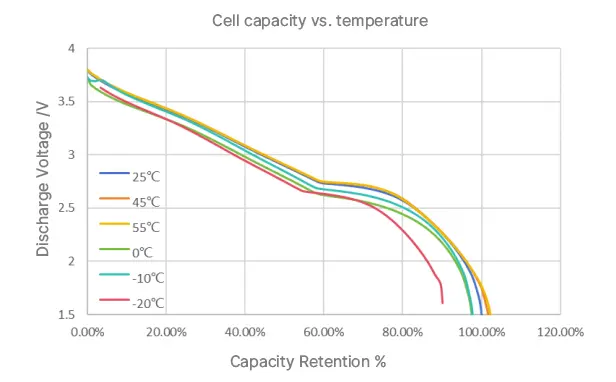
With capacity retention of 70% even at -40°C, sodium-ion batteries demonstrate exceptional low-temperature performance. This makes them well-suited for deployment in extreme temperature environments and an ideal choice for large-scale energy storage systems in cold regions.
Sodium-ion battery capacity retention at -40°C can be especially valuable for outdoor cabinets, remote energy storage systems, cold-region telecom backup power, and renewable energy installations. A sodium-ion battery low-temperature discharge test at -40°C should also consider discharge rate, voltage drop, usable energy, and recovery after the battery returns to normal temperature.
Low-temperature discharge capability does not automatically mean that charging is permitted at the same temperature. Battery designers should confirm the minimum charging temperature and ensure that the BMS blocks or limits charging when cell temperature falls outside the approved range.
thermal stability
Sodium-ion batteries can maintain normal charge and discharge cycling even at temperatures up to 80°C. They have demonstrated exceptional safety performance in tests such as nail penetration, crushing, overcharging, and over-discharging, exhibiting no fire or explosion hazards. Furthermore, they can be discharged to 0V without the risk of over-discharge, which significantly reduces safety risks during transportation.
Safety Performance and System-Level Considerations
These results can demonstrate the safety potential of a particular sodium-ion chemistry, but system-level safety still depends on cell quality, electrical protection, enclosure design, thermal management, installation, and BMS configuration.
Understanding 0V Discharge
The statement that a sodium-ion battery can be discharged to 0V refers to specific cell designs and test conditions rather than every sodium-ion battery product. Users should not intentionally discharge a complete battery system to 0V unless this is explicitly permitted by the cell manufacturer and supported by the BMS and system design.
Clearly, these exceptional properties of sodium-ion batteries ensure unparalleled environmental adaptability and safety in the energy storage sector, promising broad market prospects.
Safety in Energy Storage Applications
The safety of energy storage systems is crucial for both home energy storage and Commercial & Industrial Energy Storage applications. For energy investors, balancing the cost of building energy storage projects is equally vital. Therefore, sodium-ion batteries, with their significant cost advantages, present an ideal solution for investors.
Cost Advantages of Sodium-Ion Batteries
This is because sodium-ion batteries primarily utilize sodium salts as electrode materials, which are significantly more abundant and less expensive than lithium salts. Due to the larger size of sodium ions compared to lithium ions, sodium-ion batteries offer a cost-effective alternative in applications where weight and energy density are not critical requirements.
Key Advantages Over Lithium-Ion Batteries
- Sodium salt raw materials are abundant and inexpensive. Using iron-manganese-nickel-based cathode materials cuts raw material costs in half compared to the ternary cathode materials used in lithium-ion batteries.
- Due to the properties of sodium salts, lower-concentration electrolytes can be used (at the same concentration, sodium salt electrolyte conductivity is about 20% higher than lithium electrolytes), reducing costs.
- Because sodium ions do not alloy with aluminum, aluminum foil can be used as the current collector for the anode, further reducing costs by approximately 8% and weight by approximately 10%.
Advantages of Aluminum Current Collectors
The sodium-ion battery aluminum current collector advantage is mainly related to cost, weight, material availability, and manufacturing design. Using aluminum on the anode side may also simplify material sourcing compared with battery chemistries that normally require copper current collectors.
Future Market Prospects
It is foreseeable that, with the maturation of sodium-ion battery technology and its industrial application, sodium-ion batteries, boasting superior low-temperature performance, thermal stability, and cost advantages, will occupy a crucial position in the future energy storage market.
What to Check When Choosing a Sodium-Ion Battery
Before selecting a sodium-ion battery for an energy storage project, compare:
- Capacity retention at -20°C and -40°C
- Minimum permitted charging temperature
- Discharge power available at low temperatures
- Recommended operating and storage temperature ranges
- Cycle life under the expected temperature conditions
- BMS low-temperature protection settings
- Safety test reports and certification information
- Warranty, system compatibility, and technical support
Low-temperature capacity retention should not be evaluated alone. The complete battery system must also meet the project’s voltage, power, communication, installation, safety, and service-life requirements.
FAQs About Sodium-Ion Battery Low-Temperature Performance
Sodium-ion batteries can maintain useful discharge capacity in sub-zero environments, although actual performance depends on cell chemistry, discharge rate, BMS settings, and battery design.
The example discussed in this article shows approximately 90% capacity retention at -20°C. Actual capacity retention should always be confirmed using the technical data for the specific cell or battery.
Some sodium-ion battery designs can discharge at -40°C and retain part of their rated capacity. Available power, voltage stability, and usable energy may still be lower than under normal-temperature conditions.
The optimal temperature depends on the specific cell design. The widest possible temperature range should not be treated as the ideal routine operating range, so buyers should follow the manufacturer’s datasheet.
Some sodium-ion chemistries may support low-temperature charging, but the permitted charging temperature varies by product. Charging should only occur within the approved range and under BMS protection.
Certain sodium-ion cells may tolerate discharge to 0V under defined test or transport conditions. This does not mean every battery system should be intentionally discharged to 0V, so manufacturer instructions must take priority.