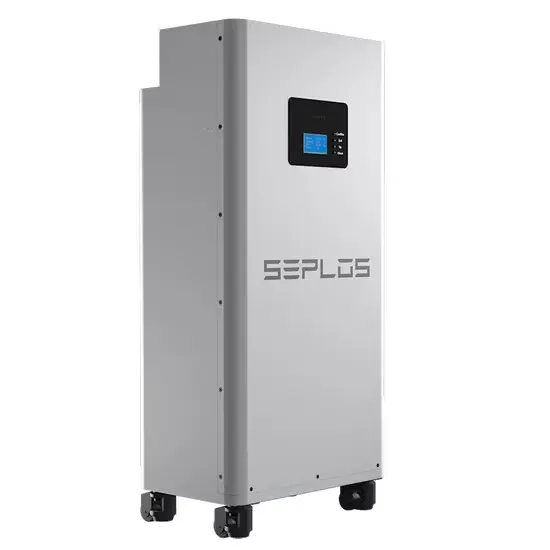
A battery kit can give installers and battery assemblers more control over how a storage system is configured, supplied and assembled. It can also simplify component sourcing when the enclosure, battery management system and supporting hardware are designed to work together.
But choosing a DIY battery kit is not simply a matter of comparing battery capacity or the number of components included. The right choice depends on the project requirements, cell compatibility, electrical design, inverter communication, assembly capability and the support available from the supplier.
For distributors, there are additional considerations. Product consistency, documentation, repeat-order availability, warranty arrangements and technical support all affect whether a kit can become a practical part of a local product range.
This guide looks at the main points installers, distributors and battery assemblers should consider before selecting a DIY battery kit for an energy storage project.
When Does a DIY Battery Kit Make Sense for a Professional Project?
A DIY battery kit sits between a fully assembled battery and sourcing every component separately.
It provides a defined hardware platform for building a battery pack, while leaving some configuration and assembly decisions to the buyer. Depending on the package, battery cells may be included or sourced independently.
For professional buyers, this arrangement can be useful when there is a clear reason to manage part of the assembly process locally.
For Battery Assemblers
Battery assemblers may prefer a kit when they already have access to suitable LiFePO4 cells and want a compatible enclosure, BMS and connection hardware.
A standardized kit can reduce the amount of time spent sourcing individual mechanical and electrical components. It also gives the assembler a defined starting point for checking the battery configuration and planning production.
For Solar Installers
Installers may consider a DIY kit when a project requires a particular battery configuration or when local assembly forms part of their business model.
However, the installer still needs to verify the battery design, inverter compatibility, installation requirements and commissioning procedure. A kit does not automatically become a ready-to-install battery simply because its main components are supplied together.
For Distributors and Energy Storage Brands
Distributors may use battery kits to serve customers who have their own assembly capabilities or prefer to source cells locally.
For energy storage brands, a suitable kit platform may also provide a starting point for local product development, provided the manufacturer can support the required technical documentation, product configuration and agreed customization scope.
A DIY kit is not necessarily the best option for every project. Where the customer needs a finished, tested battery with minimal local assembly, a complete battery product may be more appropriate.
Define Project Requirements Before Selecting a Kit
Before requesting quotations, establish what the battery kit needs to support. This makes it easier to compare suppliers and reduces the risk of choosing a package that looks suitable but does not fit the final application.
Application and Operating Requirements
Start with the intended application.
A residential solar storage project, an off-grid installation and a locally assembled battery product may have different requirements for capacity, power output, installation format and future expansion.
Consider the expected charging and discharging pattern, connected equipment, operating environment and maintenance arrangements.
Electrical System Requirements
The battery kit must match the electrical design of the complete system.
Confirm the required nominal voltage, battery capacity, charging and discharging current, inverter requirements and communication interface.
Capacity and power should not be treated as interchangeable. A battery may have sufficient stored energy but still be unsuitable for an application if its permitted output cannot support the required loads.
Installation and Mechanical Requirements
Available installation space can influence the choice of enclosure.
Consider the battery dimensions, weight, mounting arrangement, access for maintenance, ventilation requirements and environmental conditions.
For projects where several battery units may be installed together, also consider cable routing, connection access and the space required for safe maintenance.
Commercial Requirements
The expected purchasing quantity and future demand should be considered before selecting a platform.
A kit that works well for a single installation may not be the most practical choice for a distributor planning repeat orders.
It is worth discussing initial order quantities, expected annual demand, spare parts, product availability and the possibility of maintaining the same configuration across future batches.
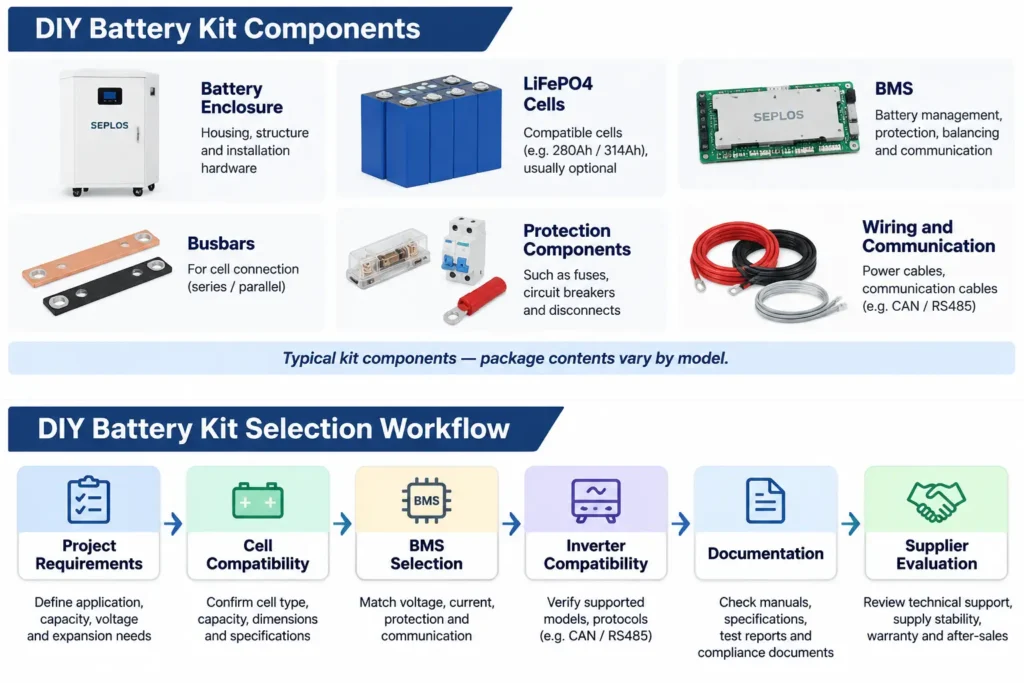
Review the Kit Scope: What Is Included and What Is Not
Two battery kits can look similar in product photographs while having quite different package contents.
For professional buyers, the most reliable way to compare them is to review the exact bill of materials (BOM) and packing list for each model.
Battery Enclosure and Mechanical Components
The enclosure provides the mechanical structure for the assembled battery pack.
Check the supported cell dimensions, internal arrangement, terminal access, mounting design and available space for the electrical components.
Depending on the model, the package may also include brackets, covers, handles, wheels, insulation materials and other mechanical hardware.
Battery Cells
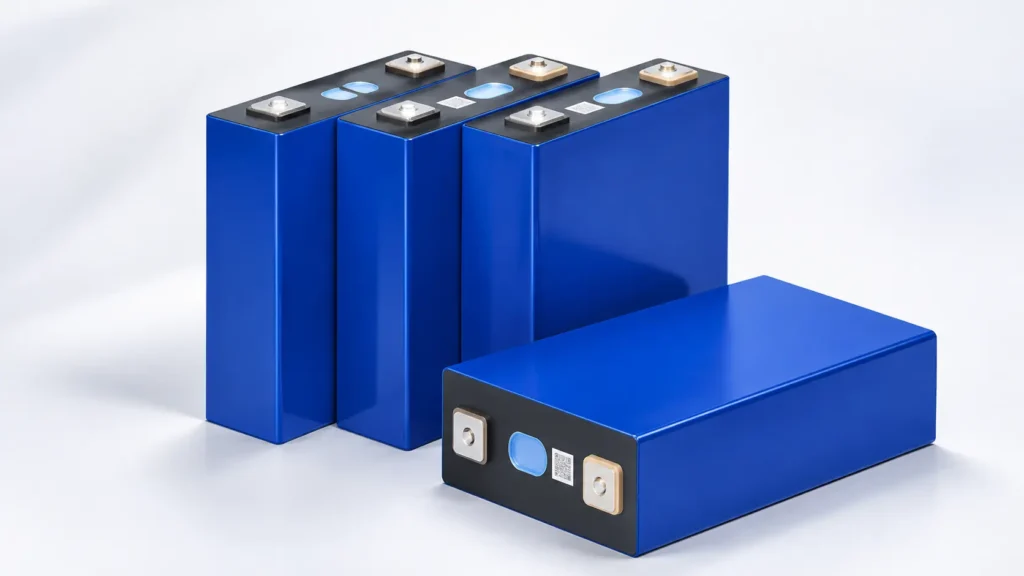
Some kits are supplied without battery cells, allowing the buyer to source compatible cells independently.
Other packages may include selected LiFePO4 cells as part of a bundle.
Do not assume that cells are included simply because a product photograph shows a complete battery pack. Confirm the exact package configuration and cell model in writing.
Electrical and Monitoring Components
Depending on the model, a kit may include a BMS, busbars, cables, fuses, connection boards, display hardware, balancing components and communication accessories.
The included components should be checked against the intended battery configuration.
For example, confirm whether the quoted package includes the required communication cables, protection components and installation accessories, rather than assuming these are standard across the product range.
Documentation and Additional Items
An installation manual, wiring diagram, component list and relevant technical documents are also important parts of a professional supply arrangement.
Before ordering, ask the supplier to identify:
- Components included in the standard package
- Items that must be purchased separately
- Compatible cell models
- Supported electrical configurations
- Available assembly documentation
- Product revision or configuration differences
A clear package definition makes quotations easier to compare and helps prevent unexpected costs during assembly.
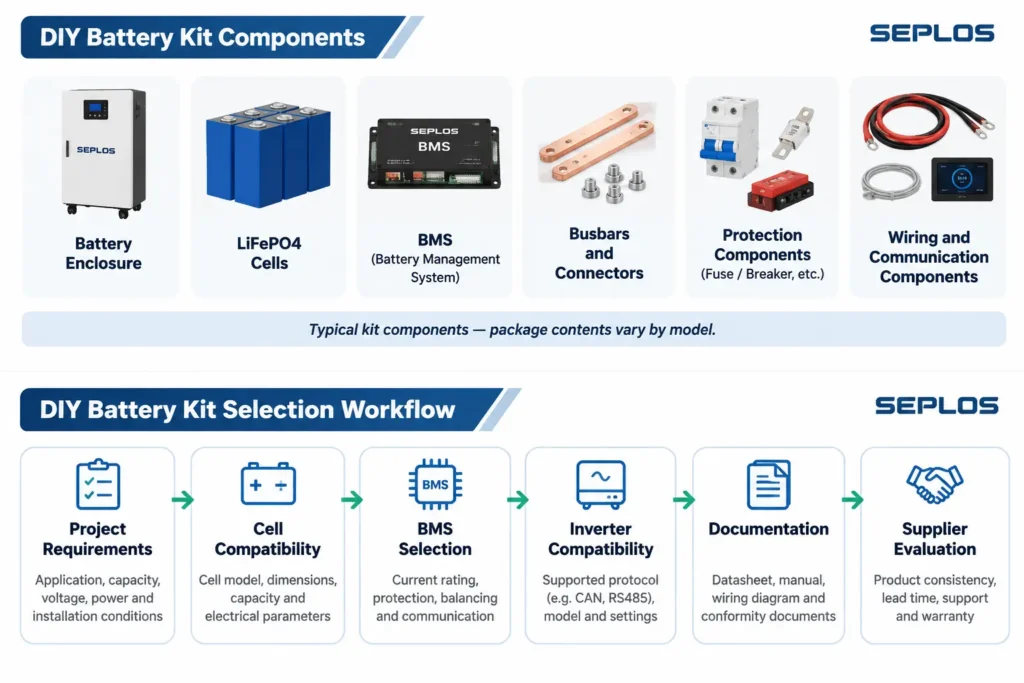
Confirm Cell and Electrical Compatibility
Cell compatibility should be checked before selecting or purchasing a battery kit.
A cell that has the correct nominal voltage and capacity is not necessarily suitable for a particular enclosure or electrical design.
Mechanical Compatibility
Compare the actual cell dimensions with the enclosure specifications.
Pay attention to cell length, width, height, terminal positions, electrode spacing and the space required for insulation and mechanical support.
Even cells with similar capacity ratings can have different physical dimensions and terminal arrangements.
Electrical Compatibility
The cell chemistry, voltage characteristics, capacity and permitted operating current must match the intended battery configuration.
The number of cells connected in series and any parallel arrangement must follow the kit manufacturer’s approved design.
Cell specifications should be checked against the manufacturer’s datasheet rather than relying on a general product description.
Cell Consistency and Traceability
For professional battery assembly, the selected cells should be assessed according to the manufacturer’s requirements.
Relevant information may include cell model, production batch, capacity test results, internal resistance and storage condition.
Where cells are supplied separately, agree in advance who is responsible for incoming inspection and compatibility verification.
For a deeper explanation of LiFePO4 cell technology, refer to the relevant technical documentation and Seplos battery technology resources.
Verify BMS, Inverter and Communication Compatibility
A compatible battery management system and inverter are essential to the operation of an assembled battery pack.
This is an area where professional buyers should request model-specific confirmation rather than relying on general statements such as “compatible with most inverters.”
BMS Configuration
Check that the BMS matches the intended cell series configuration and electrical requirements.
Important considerations include voltage range, continuous and peak current limits, temperature monitoring, protection settings, balancing functions and the supported firmware.
The BMS specification should be reviewed alongside the selected cells and inverter, not as an isolated component.
Inverter Communication
CAN and RS485 are common communication interfaces in energy storage systems.
However, sharing the same physical communication interface does not necessarily mean that two devices use the same communication protocol.
Confirm the inverter manufacturer, exact model, firmware version, supported protocol and required communication settings.
Where compatibility has not already been verified, request confirmation before committing to a large order.
For a more detailed explanation of battery protection, cell monitoring and communication, see our guide to the LiFePO4 Battery Management System.
Plan Assembly, Quality Control and Commissioning
A battery kit can simplify component sourcing, but it does not remove the need for a controlled assembly and testing process.
For professional installations and local battery production, the assembly procedure should follow the manufacturer’s model-specific documentation and applicable safety requirements.
Assembly Documentation and Work Procedures
Before production or installation begins, confirm that the correct assembly manual, wiring diagram and component specifications are available.
The assembly team should understand the approved cell arrangement, mechanical fixing requirements, connection layout and electrical protection design.
A general assembly video should not replace the technical instructions for the exact kit version.
Incoming Inspection and Assembly Quality
The condition and specifications of incoming components should be checked before assembly.
This includes verifying the cell model, component quantities, mechanical parts, electrical connections and any supplied protection devices.
Assembly quality also depends on correct insulation, mechanical fixing, terminal connections, polarity verification and adherence to the specified tightening requirements.
These checks should be documented as part of the assembly process.
Testing and Commissioning
Before a battery pack enters service, its completed configuration should be checked against the approved design.
The commissioning process may include electrical inspection, protection verification, BMS configuration, monitoring checks and communication testing with the intended inverter.
For a model-specific example, see the Seplos Mason 280L DIY Battery Kit Assembly Guide.
The exact procedures and acceptance criteria must always follow the relevant product documentation.
Review Documentation and European Market Requirements
For installers and distributors serving European customers, product documentation should be considered before the first commercial order.
A battery kit may contain several components sourced from different manufacturers. The documents available for one component should not automatically be treated as evidence that the complete assembled battery system meets every applicable requirement.
Product and Technical Documentation
Ask for the documents relevant to the exact product configuration.
These may include:
- Product datasheets and technical specifications
- Battery cell documentation
- BMS and electrical component information
- Assembly and installation manuals
- Applicable test reports and conformity documentation
- Product labels and identification information
- Warranty terms and maintenance instructions
The exact documents required depend on the product, its intended use and the applicable market requirements.
Transport and Traceability
Battery transport documentation should also be confirmed with the supplier and logistics provider before shipment.
For repeat orders, distributors and assemblers should establish a clear way to identify product versions, component batches and any approved changes.
This becomes particularly important when the same battery kit is assembled repeatedly or sold through different distribution channels.
Local Installation and After-Sales Responsibilities
The party responsible for assembly, installation, commissioning and customer support should be clearly identified.
For European projects, local electrical installation requirements, applicable product rules and the responsibilities of manufacturers, importers and distributors need to be considered.
Before placing an order, confirm that the available documentation and support arrangements are suitable for the intended country and application.
Evaluate the Supplier Beyond the Unit Price
A low initial quotation does not necessarily represent the best value for a distributor or installer.
The quality of the technical information, consistency of the product configuration and availability of support can have a direct effect on installation work and future customer relationships.
Technical Support
A supplier should be able to clarify cell compatibility, BMS configuration, inverter communication and package contents.
For installers, getting an accurate technical answer before a project begins can prevent unnecessary delays during commissioning.
For distributors, clear documentation also makes it easier to support downstream customers.
Product Consistency and Supply Continuity
If a battery kit is intended for repeated orders, check how the supplier manages product revisions and component changes.
Ask whether the same enclosure, BMS configuration and supporting hardware can be maintained across future batches.
If a component needs to be replaced or updated, clarify how the change will be communicated and whether compatibility documentation will be provided.
Commercial and After-Sales Arrangements
Before establishing a supply relationship, discuss the points that affect the overall purchasing process:
- Minimum order quantities
- Sample and initial order arrangements
- Production and delivery lead times
- Spare parts availability
- Warranty scope and claims procedures
- Technical support channels
- Packaging and shipping arrangements
- OEM or ODM customization requirements
For distributors, these details are important when building a product range that can be supported over time.
Choosing the Right Supply Model and Exploring Seplos DIY Kits
Not every battery project requires the same purchasing arrangement. The right supply model depends on how much assembly, configuration and customization the buyer intends to manage.
Standard DIY Battery Kit
A standard kit is suitable when the available enclosure and component configuration already match the project requirements.
It can provide a defined starting point for local assembly without requiring the buyer to source every mechanical and electrical component separately.
Fully Assembled Battery
A finished battery may be more appropriate when the installer or distributor wants a ready-made product with less local assembly work.
This can reduce the amount of assembly and integration managed by the buyer, although the finished product still needs to match the installation and inverter requirements.
Customized or Local Assembly Projects
Some businesses need a different supply arrangement because of local branding, product configuration or manufacturing requirements.
In these cases, the buyer should clarify the expected customization scope, technical responsibilities, testing arrangements, documentation and production requirements before moving forward.
Seplos DIY Battery Kit Options
Seplos offers DIY battery kit platforms under the MASON and DNA product ranges, with different enclosure formats and configurations.
The available options include different installation formats and battery configurations. The exact compatible cells, BMS arrangement and included components vary by model.
For professional buyers, the best starting point is to identify the intended application, preferred cell model, electrical requirements and required order quantity before selecting a specific kit.
Explore the Seplos DIY LiFePO4 Battery Kit range to review the currently available product options.
For more specific information about Mason configurations and applications, see our Seplos Mason Kit guide.
A suitable kit should be selected around the complete project requirements, not simply the highest advertised capacity or the lowest initial price.
FAQs About DIY Battery Kit Selection
Who are DIY battery kits suitable for?
DIY battery kits are generally suited to battery assemblers, technically qualified installers, distributors serving customers with assembly capabilities and businesses developing local battery products. The suitability of a kit depends on the assembly resources, technical requirements and responsibilities of the buyer.
Are battery cells always included in a DIY battery kit?
No. Package contents vary by product and supplier. Some kits provide an enclosure and supporting components without cells, while other configurations may include matched LiFePO4 cells. Buyers should confirm the exact BOM and packing list before ordering.
What should installers check before selecting a battery kit?
Installers should confirm the intended application, battery voltage, capacity, cell model and dimensions, BMS configuration, inverter compatibility, installation conditions and available technical documentation. The exact product configuration should be verified before purchase.
What should distributors request from a battery kit supplier?
Distributors should request the current product datasheet, complete BOM, package contents, cell compatibility information, assembly documentation, applicable conformity and transport documents, warranty terms and details of technical support. Repeat-order arrangements and product revision management should also be discussed.
When is a complete battery better than a DIY battery kit?
A complete battery may be more suitable when the buyer needs a finished product with less local assembly and integration work. A DIY kit is more appropriate when the buyer has the technical resources to manage cell selection, assembly, testing and the responsibilities associated with the final battery configuration.
Discuss Your DIY Battery Kit Requirements with Seplos
Selecting the right battery kit starts with a clear understanding of the intended project.
If you are an installer, distributor or battery assembler, prepare your target application, preferred cell model, required battery configuration, inverter information and expected order quantity.
The Seplos team can then discuss the available DIY kit options and the technical information needed to evaluate a suitable configuration.