
In renewable energy and energy storage systems, connecting multiple battery packs in parallel is common to increase capacity and power. However, a frequent observation is that these parallel packs don’t share the charging and discharging current equally. How does this inconsistency happen? And how can it be fixed? This article explains in detail.
Understanding the principles behind a parallel battery connection is essential for maintaining balanced current distribution, improving battery lifespan, and ensuring reliable energy storage performance.
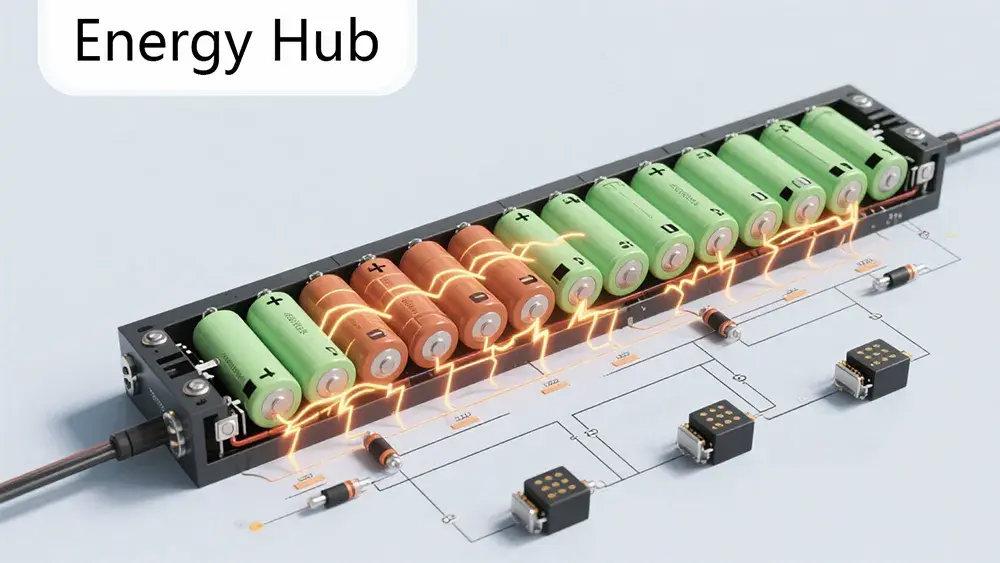
Part 1: Intrinsic Differences Between Batteries Are the Root Cause
1. Inconsistent Battery Capacity
Batteries from different production batches, ages, or cycle counts naturally have different actual capacities. A battery with a larger capacity can “push harder” during discharge, naturally delivering more current.
Example:
If one pack is 100Ah and another is 80Ah under the same load, the 100Ah pack will deliver more current, leading to uneven distribution.
2. Different Internal Resistance
Batteries with lower internal resistance allow current to flow more easily. Conversely, higher internal resistance restricts current flow.
Case Study:
When two batteries with internal resistances of 0.1Ω and 0.2Ω are connected in parallel, the 0.1Ω battery will carry a larger discharge current.
3. Varying Aging Levels
As batteries age, their capacity decreases, and internal resistance increases. Older batteries naturally cannot match new batteries and will deliver less current.
Part 2: External Connection Factors Also Matter
1. Inconsistent Connection Wire Resistance
Differences in the resistance of the connecting wires directly affect the voltage drop along them, causing uneven current sharing.
Real Situation:
If one set of wires has 0.05Ω resistance and another has 0.1Ω, the pack with the lower resistance wires will naturally carry more current.
2. Poor Connections
Problems like oxidation or loose connections at battery terminals create extra contact resistance. This hinders normal current flow and can even create a risk of local overheating.
Part 3: The Impact of Operating Environment
1. Temperature Differences
Batteries are very sensitive to temperature. Higher temperatures can improve discharge capability, while lower temperatures weaken performance.
Example:
A battery pack operating at 30°C will have significantly higher discharge capability and current output than one at 15°C.
2. Uneven Load Distribution
If the system load isn’t properly balanced across the parallel packs, some packs will end up carrying more current than others.
Part 4: Solutions: How to Achieve Consistent Current in Parallel Packs?
For systems using batteries in parallel, achieving balanced current sharing requires proper wiring design, matching battery characteristics, and optimized connection methods.
The most effective methods are:
- Use a Busbar
Connect the power cables from all battery packs to a single, common busbar. This physically ensures “fair sharing” of the current.
- Uniform Connection Wire Length and Gauge
Ensuring all battery packs have connecting wires of the same length and thickness (same resistance) is key to maintaining current balance.
Optimize Your Parallel Battery System with Seplos
If you are designing a battery energy storage system with multiple battery packs in parallel, Seplos can provide professional technical support for battery configuration, current balancing, and customized energy storage solutions.
Contact our team to discuss your battery system requirements and find a reliable solution for your application.
FAQs About Parallel Battery Connection
Batteries connected in parallel may have uneven current sharing because of differences in capacity, internal resistance, aging level, connection resistance, and operating temperature.
Yes. Lithium batteries can be connected in parallel when they have compatible voltage, capacity, battery chemistry, and proper connection methods. Correct design is important to maintain safety and performance.
Current balance between batteries in parallel can be improved by using batteries with similar specifications, equal-length cables, proper busbar connections, and consistent operating conditions.
Different charging currents are usually caused by variations in battery resistance, state of charge, battery age, cable resistance, and connection quality.
The best way to connect batteries in parallel is to use matching batteries, identical cable lengths and sizes, and a common busbar to ensure stable and even current distribution.