
Are you searching for a safe and reliable high voltage battery energy storage system? Let’s explore the essential features and characteristics such a system must possess, how these are reflected in its electrical design, hardware design, and overall philosophy, and how to use these critical factors to select the safest and most dependable high-voltage BESS.
High-voltage BESS offers unparalleled advantages over other storage methods. It’s easy to deploy, responds rapidly, and holds an unshakable position in commercial & industrial (C&I) and utility-scale grid applications. A safe and reliable system is crucial for ensuring the return on investment (ROI) of large-scale energy storage projects. The challenge lies in identifying which high-voltage batteries are worth purchasing and which could jeopardize the entire project, leading to investment failure.
In this comprehensive guide, we’ll explain the key factors to consider so you can confidently select a safe and reliable high-voltage BESS.
Part 1: What is a High-Voltage Battery Energy Storage System?
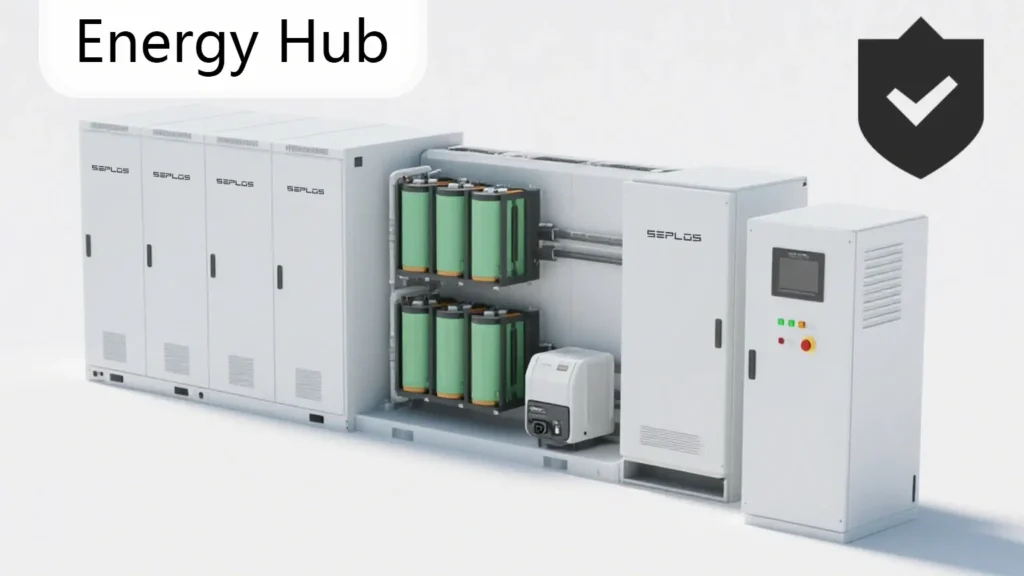
A high-voltage BESS is an energy storage solution with a nominal DC voltage typically 600V or higher, designed for centralized electricity storage and discharge. It centers around high-voltage LFP (LiFePO4) batteries, integrated with a Battery Management System (BMS), high-voltage DC control systems (e.g., DC distribution cabinets, pre-charge units), power conversion equipment (like PCS – Power Conversion Systems), and an Energy Management System (EMS). It’s widely used in C&I storage, grid peak shaving, microgrids, and integrated solar-storage-charging applications. Key characteristics include:
- High Voltage: Typically 600V, 768V, 800V, 1024V, or up to 1500V.
- Large Capacity: Supports higher power and energy configurations, suitable for medium to large-scale applications.
These two points clearly distinguish high-voltage from low-voltage batteries.
Part 2: What are the Advantages of High-Voltage BESS?
Compared to low-voltage residential systems, high-voltage BESS offers significant advantages:
- Higher system energy conversion efficiency, minimizing losses.
- Enhanced electrical safety factors.
- Support for significantly larger power output.
- Superior scalability.
- More suitable for long-distance power transmission.
This makes high-voltage BESS ideal for building large-scale storage networks or utility-scale installations.
Part 3: What Protection Must a High-Voltage BESS Have?
Safety is paramount. When selecting a system, ensure it incorporates these essential protection mechanisms:
System Self-Protection:
- Multi-level BMS protection coordination.
- Overcharge Protection.
- Over-discharge Protection.
- Overcurrent Protection.
- Short-Circuit Protection.
Personnel Safety Protection:
- Insulation Resistance Monitoring & Protection.
- Reverse Polarity Protection.
- High-Voltage Interlock Loop (HVIL).
These protections form the essential safety baseline. Eliminate any high-voltage battery system lacking these mechanisms from consideration.
Part 4: Does the System Have an Excellent Thermal Management System?
High-voltage BESS operate at high power levels, often running 24/7. This generates significant heat. Excessive internal temperatures can cause irreversible damage and safety incidents. Therefore, understanding the system’s thermal management is essential. Look for effective cooling methods:
- Air Cooling (Forced Convection/Fans).
- Air Conditioning (Refrigerant Cooling).
- Liquid Cooling.
Cooling efficiency and cost vary. Choose the optimal solution based on your project budget.
Part 5: Does the System Include Fire Suppression?
While LFP-based systems are inherently safe, protection layers can fail, or extreme events might cause thermal runaway. A final line of defense is a robust fire suppression system. Ensure the high-voltage BESS includes:
- Smoke & Combustible Gas Detection Systems.
- Smoke Ventilation/Extraction.
- Explosion Venting (Ventilation).
- Integrated Fire Suppression (e.g., aerosol, clean agent).
Verify these features in the supplier’s documentation. Exclude suppliers who cannot provide them.
Part 6: Is the System Capacity Scalable?
A reliable system must be scalable. Why? As an installer, you face diverse customer power needs. Scalable systems, easily expanded via parallel connection, provide the flexibility to meet varying demands. Furthermore, as a customer’s business grows, their power requirements will likely increase – scalability future-proofs the investment.
Part 7: How Intelligent is the System Management?
High intelligence is a key trend. Cloud platform management is crucial, enabling:
- Remote Monitoring & Smart Cloud O&M (eliminating need for on-site expert visits).
- Intelligent Cell Balancing Strategies & Proactive System Alerts (ensuring cell consistency throughout lifespan).
- Multiple Operating Modes (Supporting VPP, Grid-Tied, Off-Grid operation).
Highly intelligent systems drastically reduce maintenance costs, especially beneficial for installers with global operations.
Part 8: What is the System Integration Level?
High integration determines system stability. Key indicators include:
- Internal Integration of PV, Storage Modules, and PCS with Unified Bus Control.
- “All-in-One” Design & Modular Installation.
High integration and standardization facilitate seamless delivery, simplify installation & O&M, and reduce shipping and commissioning costs.
Part 9: Why are Certifications Crucial for High-Voltage BESS?
While suppliers advertise features, certifications provide independent verification of safety and performance claims. They are proof that the system passed rigorous testing by accredited labs. Essential certifications include:
- CE (Conformité Européenne): Compliance with EU health, safety, and environmental standards.
- UL (Underwriters Laboratories): Compliance with stringent electrical safety standards (e.g., UL 1973, UL 9540A).
- RoHS (Restriction of Hazardous Substances): Ensures batteries are free of specific hazardous materials.
- UN38.3: Certifies safety for air and sea transport of lithium batteries.
- IEC 62133: International safety standard for portable and stationary lithium batteries.
If a supplier cannot provide these certifications, the system may be unsafe. Always request them before purchase.
Build Your Reliable High Voltage Energy Storage Solution with Seplos
Choosing the right high voltage battery energy storage system requires reliable technology, safety design, and professional support. Seplos provides advanced BESS solutions for commercial, industrial, and renewable energy applications.
Contact our team to discuss your energy storage requirements and find the right solution for your project.
FAQs about High Voltage Battery Energy Storage Systems
Absolutely. Individual users should opt for highly integrated high-voltage BESS solutions, installed by qualified local electricians.
For medium to large-scale projects (e.g., >100kWh), liquid cooling is recommended for its superior temperature control precision and heat dissipation efficiency. For smaller or cost-sensitive projects, air-cooling offers a more economical solution.
Consider researching established manufacturers like Seplos, experts in BESS manufacturing. Their newly launched product, such as the Seplos UltraPower 100, may meet your requirements.
