
Are You Buying “Emergency Insurance” or an “Income-Generating Asset”?
Over the past two years, extreme weather has become more frequent, and electricity bills have been rising noticeably. Whether you’re a homeowner in the suburbs or running a small factory, you’ve probably had the same thought:
For commercial buyers, EPCs, distributors, and facility managers, the decision is not only about keeping the lights on during an outage. It is also about whether the system can reduce operating costs, support solar energy use, and create measurable long-term value.
“Do I need a backup power solution for my home or business?”
So you open a browser and search for “home backup power” or “power outage solutions.” Suddenly, you’re flooded with options—diesel generators, home UPS systems, solar batteries, and a bunch of complex systems labeled BESS.
After browsing for a while, you end up even more confused.
Aren’t they all just for supplying power during outages? What’s the difference?
Quick Answer
Energy storage and backup power are not the same. A traditional backup power system, such as a generator or UPS, is mainly used during outages. A battery energy storage system (BESS) can provide backup power, but it also works every day by storing solar energy, reducing peak electricity costs, supporting time-of-use savings, and improving energy independence.
Many people assume they’re basically the same—just different in price. But the truth is far from it.
These two solutions play completely different roles in your financial life:
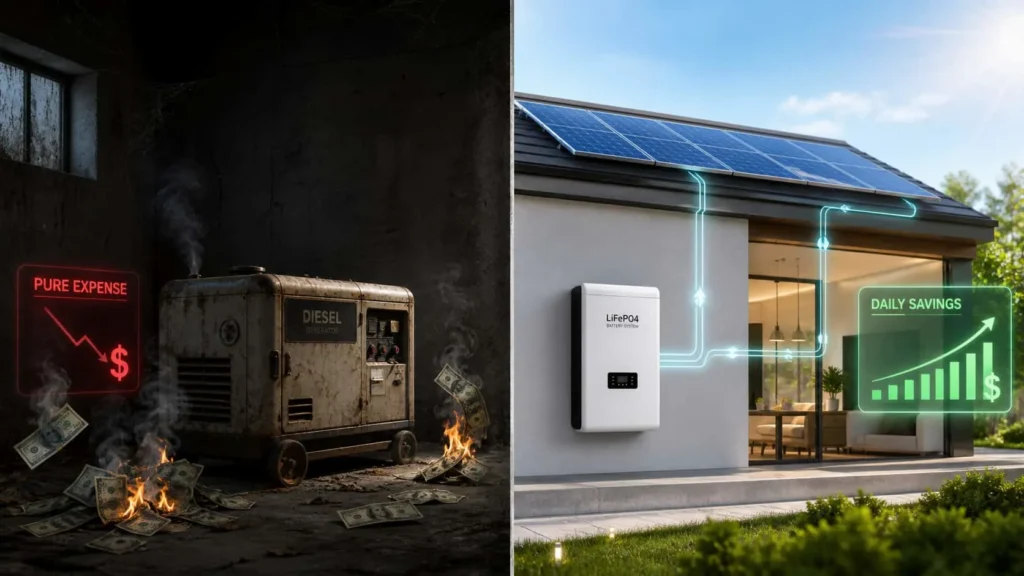
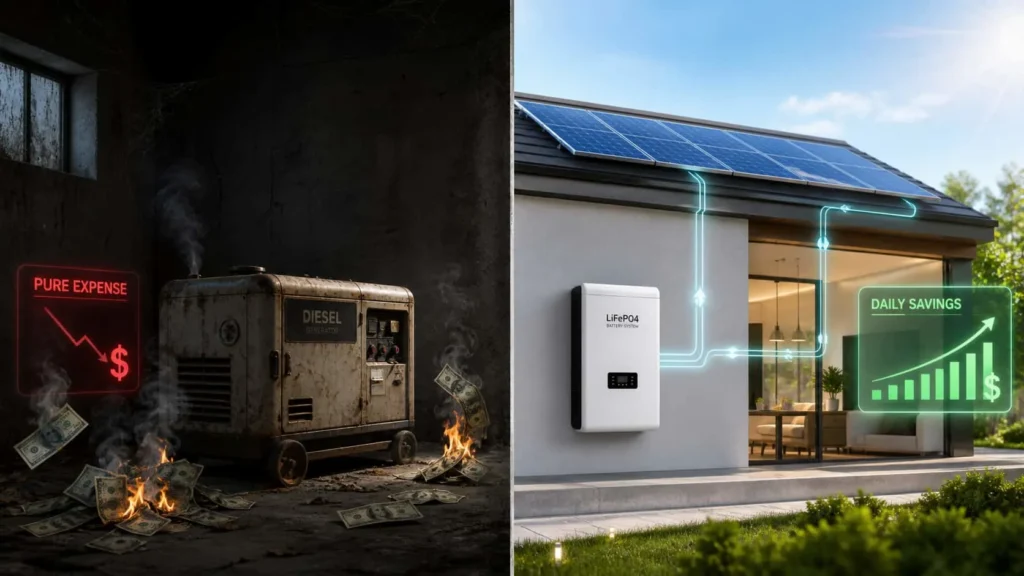
- One is a pure expense, like insurance—you keep paying for it, but only use it occasionally
- The other is an income-generating asset that can actually save (and even earn) you money every day
In this article, we’ll break it all down so you can clearly understand the difference—and choose the smartest, most cost-effective option based on your needs.
What Is a Backup Power System?
Let’s start with traditional backup power—something most people are familiar with.
Its definition is simple:
A system designed only for emergencies.
Typical examples include:
- Diesel or gas generators in your yard
- Large UPS systems in equipment rooms
How It Works
The logic is straightforward:
- Most of the time, it just sits idle
- It does not participate in your daily energy usage
- It only activates when there is a grid outage
In other words, it spends its entire life waiting for that one moment—the power goes out.
Advantages
- Low upfront cost: A small portable generator can cost just a few hundred dollars
- Unlimited runtime (in theory): As long as you keep refueling, it can keep running
Pain Points
- Pure sunk cost
If your grid is stable and outages are rare, the system sits unused 99.9% of the time.
Worse, it still requires maintenance—oil changes, battery upkeep—so it continues to cost you money without generating any return. - Noise and emissions
Generators are loud and disruptive. You can forget about a quiet evening.
More importantly, they produce carbon monoxide and must never be used indoors—every year, accidents happen due to improper use. - Poor user experience
When a storm hits and the power goes out, it’s not automatic.
You may have to go outside in the rain, start the generator manually, and hope it works.
Not exactly “smart living.”
What Is a Battery Energy Storage System (BESS)?
Now let’s look at BESS—the future of energy systems.
At a basic level, it’s like a large battery. But in reality, it’s a complete energy management platform built on advanced lithium batteries and intelligent inverters.
Core Components
- LiFePO4 (Lithium Iron Phosphate) batteries for safety and stability
- A smart inverter system that acts as the “brain.”
How It Works
Unlike backup systems, BESS is always active—24/7, 365 days a year.
In Daily Use: Your “Energy Manager”
- Solar energy optimization
If you have solar panels, excess power generated during the day is stored instead of being sent to the grid at low compensation rates.
At night, when electricity is expensive, you use your stored energy. - Time-of-use arbitrage
Even without solar, the system charges when electricity is cheap (e.g., at night) and discharges when prices peak (e.g., evening hours).
It saves you money every single day.
During Outages: Your “Silent Guardian”
- 20ms switching time
When the grid goes down, BESS responds almost instantly. Lights may flicker briefly—or not at all.
Your computer, NAS, fridge, and air conditioner keep running. - Seamless experience
No noise. No emissions. No action required.
It quietly keeps your home or business running.
Energy Storage vs Backup Power: Key Differences
| Category | Backup Power System | Battery Energy Storage System (BESS) |
|---|---|---|
| Main Purpose | Emergency power during outages | Daily energy management plus backup power |
| Typical Examples | Diesel generator, gas generator, UPS | LiFePO4 battery system, hybrid inverter, solar battery storage |
| Daily Usage | Mostly idle unless the grid fails | Used regularly for solar storage, time-of-use savings, peak shaving, or backup |
| Power Source | Fuel, grid charging, or stored UPS battery | Solar power, grid charging, or combined energy sources |
| Outage Response | Manual, delayed, or limited depending on system type | Automatic and fast when properly designed with the right inverter |
| Noise and Emissions | Generators can be noisy and emit exhaust | Silent operation and no on-site emissions |
| Maintenance | Fuel storage, engine maintenance, oil changes, battery checks | Battery monitoring, inverter checks, software/BMS management |
| ROI Potential | Usually low or negative because it waits for emergencies | Can create daily value through bill savings, solar self-consumption, and peak cost reduction |
| Solar Integration | Limited or unavailable in most traditional systems | Strong fit for solar-plus-storage systems |
| Best For | Rare outages, limited budget, basic emergency needs | Homes, businesses, factories, and sites that need backup plus long-term energy savings |
Energy Storage or Backup Power: Which One Is Right for You?
Scenario A: You Just Want Peace of Mind
Profile:
- Stable grid, rare outages
- No solar system
- Very low electricity prices
- Limited budget
Recommendation:
A portable generator or small UPS is enough.
Since your usage is minimal, there’s no need to invest in a full BESS. Keep it simple and cost-effective.
Scenario B: Comfort-Focused Homeowner
Profile:
- Already have or plan to install solar
- High electricity bills (especially at night)
- Want reliable, quiet backup during extreme weather
Recommendation:
BESS is the best choice—no question.
A system like the Seplos Mason 16kWh home battery allows you to:
- Store excess solar energy
- Avoid peak electricity prices
- Enjoy quiet, automatic backup
This is what modern energy living should look like.
Scenario C: Efficiency-Driven Business Owner
Profile:
- Running a factory, restaurant, or data center
- High demand charges on electricity bills
- Cannot tolerate even brief power interruptions
Recommendation:
You need a power system that generates value.
Traditional generators can’t:
- Prevent millisecond-level outages
- Reduce demand charges
A system like the Seplos UltraPower 261 can:
- Stabilize power instantly
- Reduce peak demand costs
- Protect sensitive equipment
It’s not just backup—it’s a strategic asset.
Why BESS Is More Than Backup Power
The core message is simple:
Times have changed.
Traditional backup systems are like safes—sitting idle, waiting for emergencies, costing you money over time.
BESS, on the other hand, combines:
- Defense (backup power)
- Offense (saving money and generating ROI)
It works for you every day—and protects you when it matters most.
So when you can install an energy asset that:
- Saves you money
- Pays for itself in ~5 years
- Runs silently and cleanly
Why settle for a noisy, fuel-hungry machine?
Stop paying for an expensive grid that works against you.
If you’d like to explore how a LiFePO4-based smart energy storage system can deliver both energy independence and financial returns for your home or business, feel free to contact the Seplos team.
Let us help you calculate how much you could be saving.
FAQ About Energy Storage vs Backup Power
Backup power is mainly designed for emergencies, while energy storage can provide backup power and also operate daily to store solar energy, reduce peak electricity costs, and improve energy independence.
No. A generator produces power from fuel during outages, while a BESS stores electricity and can be used for backup, solar self-consumption, time-of-use savings, and peak shaving.
Yes. A BESS can be designed to provide backup power during outages, especially when paired with a hybrid inverter and properly sized battery capacity.
It depends on the application. A generator may be enough for rare outages and low budgets. BESS is better when users also want quiet operation, solar integration, daily savings, and long-term energy management.
Yes, in many cases. BESS can charge during low-cost periods, store excess solar energy, reduce peak demand, and discharge when electricity prices are higher. Actual savings depend on local tariffs, system size, and load profile.
