If you use energy storage, the health of your batteries directly affects your money. A lot of people ask the same question: do energy storage batteries hate cold or heat more?
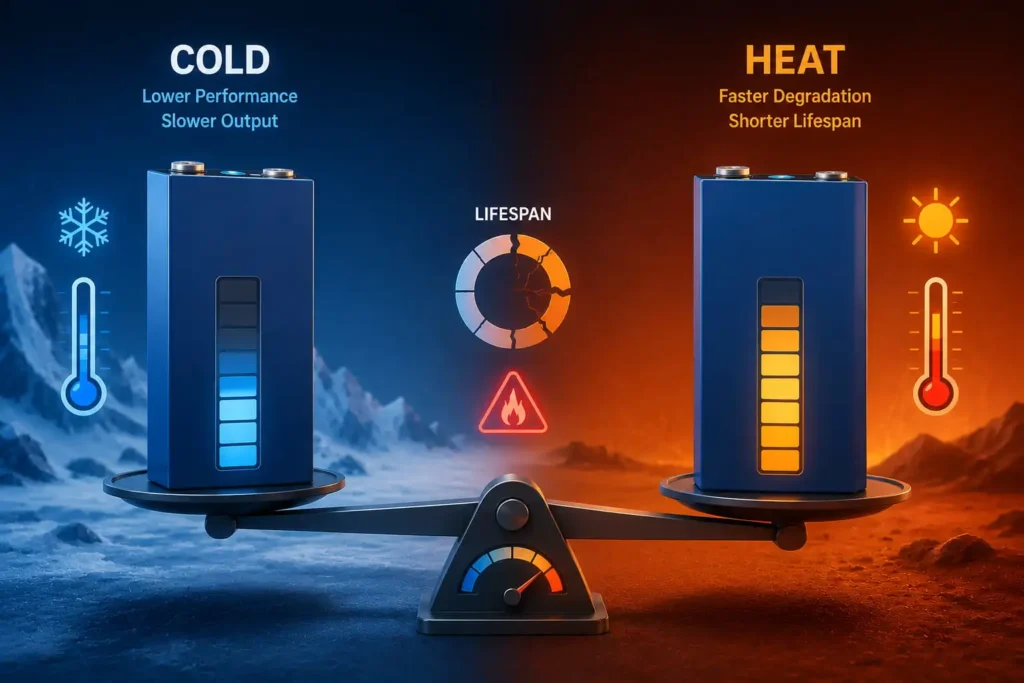
The answer is not simply one or the other. Cold makes the battery weaker right now. Heat shortens its life and can make it dangerous. Let’s look at this from three angles: performance, lifespan, and safety.
Quick Answer
For energy storage batteries, cold mainly reduces short-term performance, while heat causes more serious long-term damage. Low temperature can reduce usable power, increase internal resistance, and limit charging. High temperature accelerates battery aging, increases safety risk, and can shorten the service life of a BESS. In simple terms: cold affects how the battery works today, but heat affects how long and how safely it works over its lifetime.
Cold vs Heat Battery Storage Comparison
Cold and heat affect battery storage systems in different ways. While cold mainly causes temporary performance loss, excessive heat accelerates battery aging and increases safety risks. The key for BESS owners and installers is to keep the entire battery system operating within a stable and uniform temperature range rather than simply avoiding extreme temperatures.
| Factor | Cold Temperature | High Temperature |
|---|---|---|
| Main Impact | Reduces short-term performance and usable power | Accelerates aging and increases safety risk |
| Battery Behavior | Lithium ions move more slowly and internal resistance rises | Chemical reactions speed up and materials degrade faster |
| Usable Energy | Less energy may be available during cold conditions | Capacity may be permanently reduced over time |
| Charging Risk | Charging may be limited; very cold charging can increase lithium plating risk | Charging at high temperature can accelerate degradation and stress the battery |
| Lifespan Impact | Usually temporary if the battery is managed correctly | Often permanent and cumulative |
| Safety Risk | Lower immediate safety risk, unless charging is done incorrectly | Higher safety risk because heat can contribute to thermal runaway |
| BESS Design Focus | Preheating, charge limits, and low-temperature protection | Cooling, temperature uniformity, BMS control, and fire safety design |
| Simple Summary | Cold makes the battery weaker today | Heat makes the battery age faster and can become dangerous |
How Cold Affects Battery Storage Performance
In cold weather, things slow down inside the battery. The tiny particles that carry energy (lithium ions) move slower. The liquid inside gets thicker, like honey in a fridge. As a result, the battery’s internal resistance goes up, and it can’t push out as much power. You get less usable energy.
Signs you might notice:
- The battery percentage drops fast.
- The device feels weak or sluggish.
- Charging is limited, or the battery’s safety system stops it completely.
- The battery shuts off earlier than normal.
There is another hidden risk: charging a battery when it’s very cold can make metal needles called “dendrites” grow inside. If these needles poke through the separator inside the battery, they can cause a short circuit. But this usually only happens if you use it wrong, not just because it’s cold.
In short, Cold limits what the battery can do, but it is not an immediate danger.
How Heat Shortens Battery Storage Lifespan
Heat doesn’t make a battery feel weak right away. Instead, it quietly wears it out — fast.
1. It shortens life and the damage is forever. High heat breaks down the internal liquid and makes the active materials fall apart. If a battery often runs above 50°C (122°F), its life can be cut in half or worse. You can’t fix this damage.
2. It can start a dangerous chain reaction. Once temperatures get above about 45°C (113°F), the battery can get stuck in a bad loop: heat makes reactions faster, and faster reactions make even more heat. This can lead to smoke, fire, or explosion — the worst thing that can happen.
3. Performance gets hurt too. Heat increases internal resistance, temporarily drops capacity, and speeds up aging. Even after you cool it down, some performance is lost forever.
Real-world data shows battery life drops sharply with just a little extra heat. For example:
- 25°C (77°F) — a comfortable temperature
- 35°C (95°F) — lifetime may drop 20–30%
- 45°C (113°F) — lifetime can be cut in half
- Above 60°C (140°F) — permanent damage happens
Heat silently uses up your battery’s “life budget,” which turns into extra cost for you.
Why Heat Creates Bigger Battery Safety Risks
Almost every battery safety accident starts the same way: heat gets trapped and builds up faster and faster until it’s out of control. This is called “thermal runaway.” It’s a chain reaction:
- The protective film inside breaks down.
- The liquid starts heating up on its own.
- The positive part of the battery releases oxygen.
- Flammable materials catch fire.
The simple rule: Cold affects how well it works. Heat threatens your safety. That’s why every large battery storage system — for a home, business, or electric vehicle — must have a cooling system. No exceptions.
What Is the Best Temperature Range for Battery Storage?
For most lithium battery storage systems, moderate temperature is best. Extremely cold conditions reduce power output and charging ability, while high temperature accelerates aging and safety risk. In practical BESS design, the goal is to keep cells within a stable operating range and avoid large temperature differences between cells, modules, or cabinets.
Why BESS Thermal Management Is Critical for ROI
An energy storage system is not a one-time-use gadget. It’s a long-term asset meant to make or save you money for years. Temperature control directly affects your cost per kilowatt-hour (how much you pay for the energy you get over the system’s life). The math is simple:
- Better temperature control → slower aging → longer life
- Longer life → lower cost spread out over time → higher profit
So, managing temperature is really about managing your money. For battery makers, building a battery that handles temperatures well is just as important as giving it more energy. For system builders, a smart cooling plan matters more than just packing in more batteries.
How to Keep Batteries in the Optimal Temperature Zone
Here are the core tricks engineers use:
- Maintain your system in the ideal 20%–80% state of charge (SOC) — avoid staying at 100% or 0% for too long.
- Don’t charge or drain the battery fast when it’s cold.
- Use liquid cooling or cooling plates to keep the temperature even.
- Have the battery management system (BMS) automatically limit power based on temperature.
- Design the battery pack so all the cells stay at a similar temperature.
One sentence to remember: Total capacity isn’t the #1 thing. Even temperature is the real secret to a long system life. The best storage systems don’t just pile on more cells — they keep those cells comfortable. The future of energy storage isn’t about just having more power. It’s about smarter cooling and making batteries last.
If you’re an energy storage user, remember this: Don’t just look at how much capacity the battery has. Ask how it manages heat. That’s what protects your long-term returns.
FAQ
Cold is usually worse for short-term performance, while heat is worse for long-term battery lifespan and safety. Cold can reduce usable power and limit charging, but heat accelerates aging and can increase the risk of thermal runaway.
Batteries lose power in the cold because lithium ions move more slowly and internal resistance increases. This makes it harder for the battery to deliver power, so the available capacity and output may feel lower.
Yes, high heat can permanently damage energy storage batteries. It can accelerate electrolyte decomposition, increase side reactions, raise internal resistance, and shorten the useful life of the battery system.
A moderate and stable temperature range is best for battery storage. The exact range depends on the battery chemistry and system design, but avoiding extreme heat, extreme cold, and large temperature differences between cells is critical.
BESS thermal management is important because temperature affects performance, lifespan, safety, and ROI. Better temperature control slows aging, improves system stability, and helps reduce lifetime energy storage cost.