
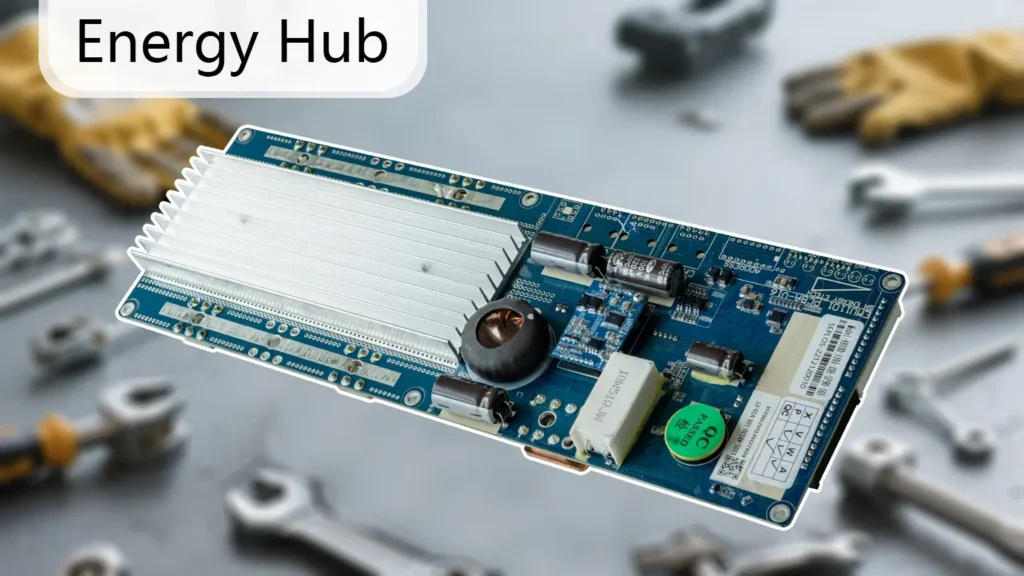
Seplos BMS is designed to provide reliable battery monitoring, protection, and communication solutions for energy storage systems. With flexible cell configuration support, inverter compatibility, and advanced protection functions, it helps users build safer and more efficient battery systems.
Seplos BMS Application Overview
This product fully supports 8-16 strings of battery cell collection; 8 strings require changing the hardware power threshold and removing the high-position socket; 15 strings and 16 strings are fully compatible, just change the battery cell sampling line 15 strings and 16 strings together, and configure the number of strings and total voltage protection parameters through the host computer. BMS can match multiple inverter manufacturers through the host computer setting protocol, and has a pre-charge function. BMS has a series of multi-layer protection functions, including single cell overvoltage/undervoltage, total voltage undervoltage/overvoltage, charge and discharge overcurrent, charge and discharge secondary overcurrent, charge and discharge high temperature, charge and discharge low temperature and short circuit. SOC, SOH, and total discharge capacity can be accurately calculated according to the characteristics of the battery cell. Parallel communication is carried out through RS485, and data monitoring is carried out through the host computer software.
Seplos BMS Communication and Monitoring
The Seplos BMS RS485 pinout configuration helps users correctly connect communication cables between battery systems, host computers, and compatible devices. It can communicate with the inverter through the CAN/485 bus.
For easier monitoring and parameter management, users can also connect with the Seplos BMS app to check battery status, operating data, and system information.
Precautions for use
1. Battery management systems cannot be used in series.
2. The withstand voltage of BMS power components is 100V.
3. If the battery module is assembled with long wires and long copper bars, you must communicate with the BMS manufacturer to make impedance compensation. Otherwise, it will affect the consistency of the battery.
4. During assembly, the protective plate should not directly contact the surface of the battery cell to avoid damaging the battery cell. The assembly should be firm and reliable.
5. During use, be careful not to let the lead heads, soldering irons, solder, etc., touch the components on the circuit board, otherwise, the circuit board may be damaged.
6. During use, pay attention to anti-static, moisture-proof, and waterproof.
7. Please follow the design parameters and usage conditions during use and do not exceed the values in this specification, otherwise, the protection board may be damaged.
8. After assembling the battery pack and protection board, if there is no voltage output or charging fails when powered on for the first time, please check whether the wiring is correct.
9. The management system does not have a 0V battery charging function. Once the battery reaches 0V, the battery performance will be seriously degraded and may even be damaged. In order to avoid damaging the battery, users need to charge it regularly to replenish the power when it is not used for a long time (storage exceeds 3 months). When in use, it needs to be charged within 12 hours after it is discharged to prevent the battery from discharging to 0V due to self-consumption.
10. The management system is not equipped with a reverse charging protection function. Do not reverse the charging input during use, otherwise, the management system and battery may be damaged.
Need help choosing or configuring a battery management system for your energy storage project? Contact Seplos for technical support and professional energy storage solutions.
FAQs About Seplos BMS Application Scope
Seplos BMS is designed for various battery energy storage applications, including residential energy storage systems, DIY battery packs, solar storage solutions, and systems requiring reliable battery monitoring and protection.
Yes. Seplos BMS supports CAN and RS485 communication protocols, allowing compatibility with multiple inverter manufacturers through proper communication settings.
The Seplos BMS communication protocol mainly includes CAN and RS485 communication, which are used for inverter connection, battery parallel communication, and system monitoring.
Yes. Users can monitor battery information including SOC, SOH, voltage, current, and operating status through compatible monitoring software and communication interfaces.
Seplos BMS provides multiple protection functions including overvoltage protection, undervoltage protection, overcurrent protection, temperature protection, and short circuit protection.