As homeowners, installers and energy storage buyers compare solar battery systems, one of the most important questions is how long the battery will retain enough usable capacity for its intended application.
Solar battery lifespan is not determined by age or cycle count alone. Battery chemistry, temperature, depth of discharge, charge and discharge rate, average state of charge, cell consistency and battery management settings can all influence degradation.
A battery may continue operating after its capacity falls below the manufacturer’s end-of-life threshold, but it will store less usable energy than it did when new. For this reason, buyers should compare cycle life, calendar life, capacity-retention conditions, warranty terms and operating requirements rather than focusing on one cycle number.
This article explains how solar batteries age, the difference between cycle life and calendar life, how LFP and NMC chemistries may differ, and which operating practices can help protect long-term battery performance.
Quick Answer: How Long Does a Solar Storage Battery Last?
A solar storage battery’s useful life depends on both cycle aging and calendar aging. Cycle aging results from charging and discharging, while calendar aging continues over time even when the battery is used infrequently.
Battery chemistry provides only part of the answer. Temperature, depth of discharge, state of charge, charge and discharge rate, BMS settings and system design can substantially affect how quickly capacity declines.
When comparing batteries, check the rated cycle life together with the test conditions, remaining-capacity threshold, product warranty and expected operating environment. A battery reaching 80% of its original capacity is not necessarily unusable, but it will provide less energy and shorter backup duration than when it was new.

Understanding Solar Battery Lifespan
Every solar battery has a limited lifespan, influenced by both usage and chemical aging. To understand how long your home energy storage system can serve you efficiently, we need to look at two key measures: cycle life and calendar life.
What Is Battery Cycle Life?
Imagine your solar battery as a wallet where you deposit and withdraw energy instead of money. Every full “deposit and withdrawal” counts as one cycle. Technically, a full charge from 0% to 100%, followed by a complete discharge back to 0%, equals one charge-discharge cycle.
In real-world use, batteries rarely operate in such extremes. For instance, if your system uses 50% of its capacity during the day and recharges at night, that still adds up to one full cycle (50% + 50% = 100%).
Cycle life refers to how many such cycles a battery can perform before its capacity drops to a certain percentage of its original level—commonly 80%.
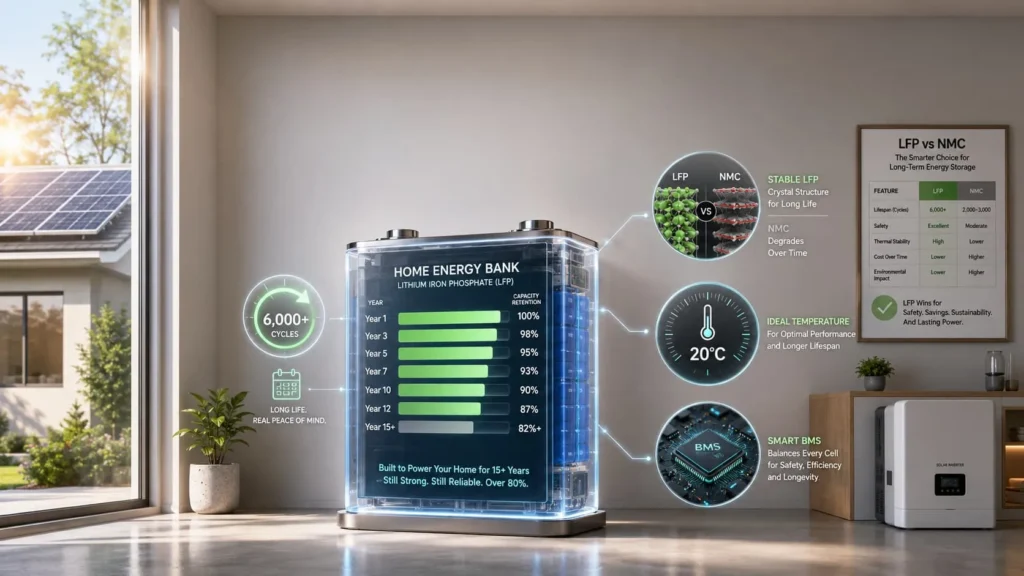
For example, a lithium iron phosphate (LFP) battery rated for 6,000 cycles can, under ideal conditions, last for over 16 years if cycled once per day. Even then, its usable capacity remains at least 80% of its initial rating. This makes cycle life one of the most important indicators of battery durability.
What Is Battery Calendar Life?
Even if you hardly use your solar battery, it still undergoes chemical aging over time. That’s because internal reactions continue slowly, even at rest, reducing its effective capacity year by year.
Calendar life refers to the total time from when the battery is manufactured until its capacity falls below a defined threshold—again, typically 80%—regardless of how often it’s used.
For instance, if a battery has a calendar life of 15 years, its capacity will likely fall below 80% after 15 years of existence, even if it has seen very few charge cycles.
In short, your battery’s true service life is whichever comes first—its cycle life or calendar life.
- For households that use their battery daily, cycle life is the key factor.
- For those that use it occasionally, calendar life becomes more relevant.
LFP vs NMC: Which Battery Chemistry Lasts Longer?
In today’s home energy storage market, two main lithium-ion technologies dominate: Lithium Iron Phosphate (LFP) and Nickel Manganese Cobalt (NMC). Though both are proven, their lifespans and safety characteristics differ significantly.
| Feature | LFP (Lithium Iron Phosphate) | NMC (Nickel Manganese Cobalt) |
|---|---|---|
| Cycle Life | Excellent (typically 6,000+ cycles) | Good (3,000–5,000 cycles) |
| Calendar Life | Up to 15+ years | Around 10–15 years |
| Thermal Stability | Very high; safer, less prone to thermal runaway | Lower; requires advanced cooling |
| Energy Density | Lower (larger volume for same capacity) | Higher (more compact size) |
Why LFP Batteries Usually Last Longer
1. Stronger chemical stability
LFP batteries have a highly stable crystal structure, with strong phosphorus-oxygen bonds that resist structural changes during charging and discharging. This minimizes battery degradation over time.
NMC batteries, however, have a layered structure that can degrade and dissolve gradually, causing faster capacity loss.
2. Better heat tolerance
High temperatures are the number one enemy of battery lifespan. LFP chemistry can handle heat far better, maintaining slower degradation rates even in warm environments.
3. Safety and longevity over compactness
While NMC offers higher energy density, LFP wins in long-term reliability, safety, and life expectancy. This is why more manufacturers—and homeowners—are shifting toward LFP-based home energy storage systems.
How to Extend the Life of Your Solar Battery
Even the most advanced batteries can lose years of potential life through improper use. Following best practices will help you maximize your solar battery lifespan and ensure consistent performance.
1. Avoid Full Charging and Deep Discharging
Try not to keep your battery constantly at 100% or let it drop to 0%. Instead, maintain a state of charge between 20–80%, for daily operation to extend your battery’s lifespan.
Extreme charge levels stress the battery’s internal materials, accelerating wear and electrolyte breakdown. An occasional full charge for system calibration is fine, but it should not become routine.
2. Keep the Battery at a Comfortable Temperature
Temperature is one of the most critical factors affecting battery degradation.
- Ideal operating range: 15°C to 25°C
- Best installation location: A cool, dry, and well-ventilated indoor area—away from direct sunlight or heat sources.
Prolonged exposure to high heat can cause irreversible capacity loss and even safety risks. Conversely, very low temperatures reduce discharge efficiency and available power output.
3. Follow Recommended Charging and Discharging Rates
Every home energy storage system has an optimal charge and discharge rate. Avoid using overly high current or “super-fast” charging, which increases internal heat and mechanical stress.
Stick to the manufacturer’s recommended settings to protect your battery’s internal structure and extend its service life.
4. Store Properly During Long Inactivity
If you won’t be using your system for an extended period—such as during travel or seasonal downtime—keep the battery charged at 50–60% before storage.
This mid-level charge minimizes chemical reactions inside the cells and slows natural capacity fade.
5. Choose a Quality Battery Management System (BMS)
A reliable Battery Management System acts as the intelligent brain of your solar storage setup. It continuously monitors voltage, temperature, and state of charge across every cell, ensuring balanced operation and protection from overcharging or deep discharging.
A smart BMS not only safeguards performance but also plays a vital role in extending the overall solar battery lifespan.
The Relationship Between Battery Lifespan and Return on Investment
Your solar battery lifespan directly affects how quickly you recover your investment in a home energy storage system. A longer-lasting battery provides more cycles of clean power, reduces maintenance costs, and allows you to depend less on grid electricity—especially in regions with high utility prices.
By choosing the right chemistry (such as LFP), maintaining proper temperature conditions, and following smart usage practices, homeowners can maximize both performance and savings for years to come.
FAQs About Solar Battery Lifespan
How long does a solar storage battery usually last?
There is no universal service life for every solar battery. Actual lifespan depends on battery chemistry, cycle frequency, depth of discharge, temperature, state of charge, charge and discharge rate, BMS settings and the manufacturer’s end-of-life definition.
What is the difference between cycle life and calendar life?
Cycle life measures degradation caused by accumulated charging and discharging. Calendar life measures aging that occurs over time, including when the battery is used only occasionally. The battery’s practical service life is affected by both.
Does reaching 80% capacity mean the battery has failed?
Not necessarily. An 80% capacity threshold is commonly used as an end-of-life reference for testing or warranty purposes. The battery may continue operating, but it will store less energy and provide shorter backup time.
Do LFP batteries last longer than NMC batteries?
LFP batteries are often selected for stationary storage where long cycle life and thermal stability are priorities. However, actual lifespan depends on the specific cell design, operating conditions and system controls, so chemistry alone should not be used to predict service life.
What information should buyers compare when evaluating battery lifespan?
Compare the rated cycle life, depth of discharge used during testing, capacity-retention threshold, operating temperature, charge and discharge rate, warranty period, energy-throughput terms, BMS functions and replacement conditions.
Make Longevity Part of Your Energy Plan
A solar storage battery isn’t just a backup—it’s a long-term investment in energy independence and sustainability. Understanding how batteries age and how to care for them can help you make better purchasing decisions and extend the lifetime of your entire solar system.
When selecting your next home energy storage solution, look for products built with safety, reliability, and smart management in mind. A high-quality system will let you enjoy stable, affordable, and renewable power for decades.
With the right technology and responsible use, your solar battery becomes more than just storage—it becomes the cornerstone of your home’s clean energy future.
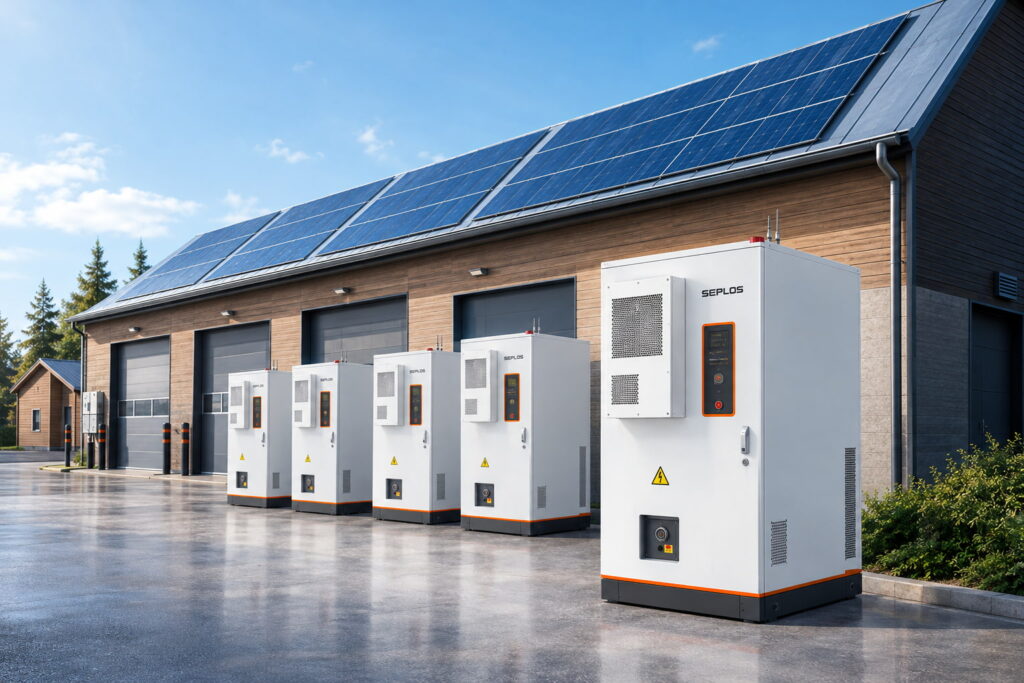
Seplos energy storage systems are designed with advanced battery management and optimized thermal control to ensure long-lasting performance, safety, and stability. Whether for residential or commercial use, Seplos helps users worldwide achieve sustainable energy independence—today and for years to come.
Contact Seplos to review battery compatibility, lifespan-related specifications and energy storage options for your project.