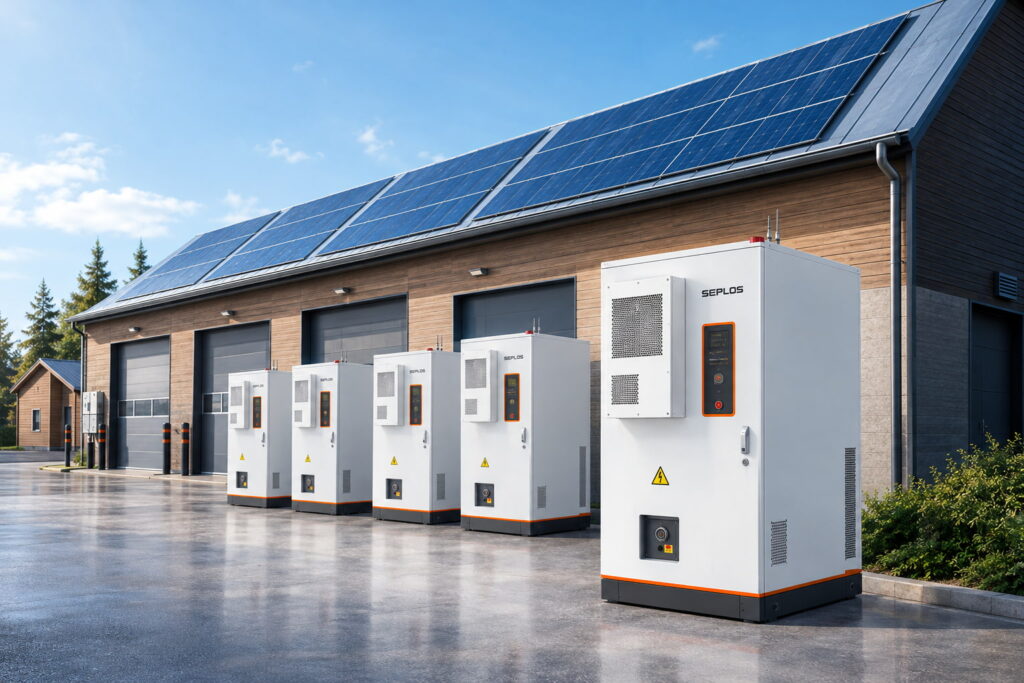
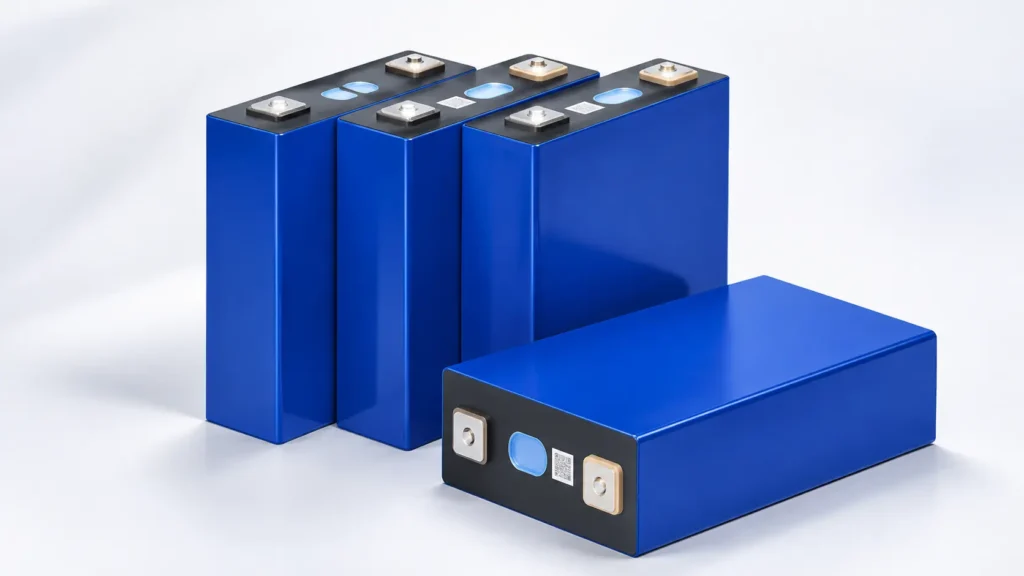
Lithium iron phosphate batteries have become a familiar choice in energy storage projects, from residential solar batteries to large commercial battery systems. Their appeal is relatively straightforward: good thermal stability, long-term cycling capability, and a chemistry suited to applications where batteries are charged and discharged regularly.
But the chemistry is only part of the story.
Two LiFePO4 battery packs can use cells with similar capacities and still perform differently in service. Cell consistency, operating temperature, charging conditions, battery management, mechanical design, and production quality all influence the result.
For installers, battery pack manufacturers, and energy storage distributors, these details matter well before a system reaches the installation site. Understanding the technology helps teams select suitable cells, assess suppliers, identify design limitations, and avoid compatibility problems.
This guide looks at how LiFePO4 batteries work, the specifications that matter in practice, what determines battery life, and how to evaluate cells and complete battery systems for professional energy storage applications.
What Is LiFePO4 Battery Technology?
LiFePO4 stands for lithium iron phosphate, a lithium-ion battery chemistry that uses lithium iron phosphate as the cathode material.
The term LFP is commonly used as a shorter name for the same chemistry.
Unlike the general term “lithium-ion,” which covers several battery chemistries, LiFePO4 refers to a specific electrode composition with its own electrical and thermal characteristics.
LFP cells are widely used in stationary energy storage because these applications often place greater emphasis on service life, safety engineering, and cost over the system’s operating life than on maximizing energy stored per kilogram.
Why LiFePO4 Is Widely Used in Energy Storage
Several characteristics make LFP suitable for battery storage projects.
Its phosphate-based cathode structure offers relatively good thermal stability compared with some nickel-rich lithium-ion chemistries. LFP cells can also provide substantial cycle life when operated within their specified temperature, voltage, and current limits.
Another consideration is material composition. LFP cathodes do not require nickel or cobalt, although the complete battery still depends on several other materials and manufacturing processes.
None of these characteristics eliminates the need for safety engineering. A reliable LFP energy storage system still requires appropriate battery management, electrical protection, thermal design, and correct installation.
How Do LiFePO4 Batteries Work?
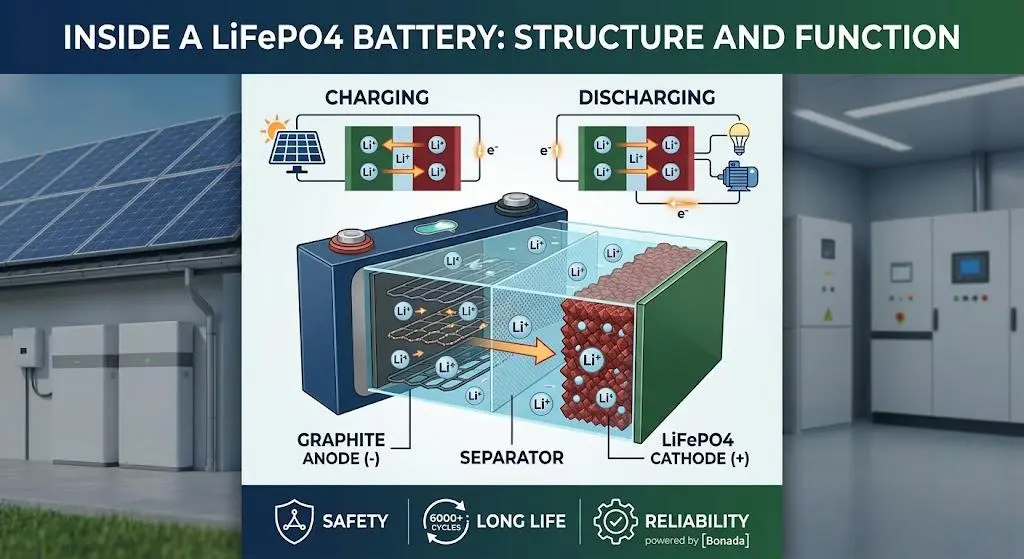
Like other lithium-ion batteries, an LFP cell stores and releases energy through the movement of lithium ions between two electrodes.
A typical cell contains a lithium iron phosphate cathode, a graphite-based anode, an electrolyte, and a separator.
During charging, lithium ions move from the cathode toward the anode and are stored within its structure. During discharge, they travel back toward the cathode. Electrons flow through the external circuit, supplying electrical energy to the connected equipment.
The separator prevents direct electrical contact between the electrodes while allowing ionic transport through the electrolyte.
From Individual Cells to Battery Packs
A single LiFePO4 cell commonly has a nominal voltage of approximately 3.2V.
One cell is rarely sufficient for a residential or commercial storage system. Multiple cells are connected in series to increase voltage, and parallel arrangements may be used where the battery design requires greater capacity.
For example, sixteen nominal 3.2V cells connected in series produce a nominal 51.2V battery configuration.
The complete battery pack also needs electrical interconnections, temperature monitoring, mechanical support, insulation, suitable protection devices, and a compatible battery management system.
For larger energy storage systems, individual battery modules may be combined into a higher-voltage architecture.
The exact arrangement depends on the application and the engineering requirements of the battery platform.
Key LiFePO4 Battery Specifications Explained
Battery datasheets contain many figures, but a few are particularly important when comparing cells and designing energy storage systems.
Nominal Voltage, Capacity and Energy
Voltage, capacity, and energy describe different properties.
Nominal voltage (V) represents a reference operating voltage for the cell.
Capacity (Ah) describes the electrical charge the cell can deliver under defined test conditions.
Nominal energy (Wh) is commonly estimated by multiplying nominal voltage by rated capacity.
For example:
- 3.2V × 100Ah = 320Wh
- 3.2V × 280Ah = 896Wh
- 3.2V × 628Ah = 2,009.6Wh
These are nominal energy calculations, not guarantees of usable energy under every operating condition.
Actual delivered energy varies with discharge current, temperature, voltage limits, aging, and battery system losses.
C-Rate and Charge/Discharge Current
C-rate describes current relative to battery capacity.
For a 100Ah cell, a 1C discharge rate corresponds to 100A. A 0.5C discharge rate corresponds to 50A.
This makes C-rate useful for comparing cells of different capacities, but it does not replace the manufacturer’s current limits.
A cell may support different continuous and short-duration current ratings. The permitted current can also change with temperature and state of charge.
For system design, the relevant limits must be taken from the specific cell datasheet.
Internal Resistance and Efficiency
Internal resistance contributes to voltage drop and heat generation when a battery delivers or accepts current.
Higher resistance can affect usable power, temperature rise, and energy efficiency.
However, internal resistance measurements must be compared carefully. AC and DC resistance tests use different methods, and values depend on temperature, state of charge, measurement equipment, and test conditions.
A lower number in one datasheet does not automatically prove that a cell will perform better than another cell tested differently.
LiFePO4 Cell Formats and Battery Pack Design
LiFePO4 cells are available in several physical formats, including cylindrical, prismatic, and pouch designs.
The cell format affects mechanical packaging, electrical connections, cooling, manufacturing processes, and serviceability.
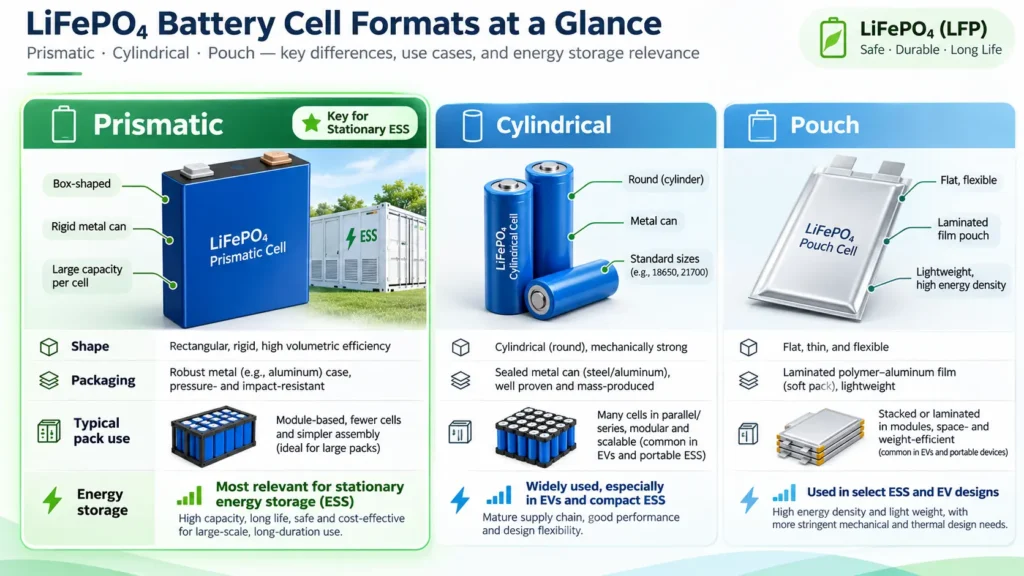
For stationary energy storage, large-format prismatic cells are commonly used because they allow substantial capacity to be packaged into relatively compact battery modules.
Prismatic LiFePO4 Cells
Prismatic cells use a rectangular enclosure with external electrical terminals.
Their shape makes it possible to arrange cells closely inside a battery enclosure or module.
For battery pack manufacturers, the design must also account for cell dimensional tolerances, electrical insulation, terminal connections, and any compression or expansion requirements specified by the cell manufacturer.
Cylindrical and Pouch Cells
Cylindrical cells use a rigid round enclosure. They offer established manufacturing processes and can be arranged into modular cell groups.
Pouch cells use flexible packaging, which can provide design flexibility but requires appropriate mechanical support.
Neither format is automatically superior in every application.
The appropriate choice depends on the battery architecture, manufacturing process, thermal management, mechanical requirements, and target cost.
Why Pack Design Matters
Cell selection is only the beginning of battery engineering.
Busbar connections, terminal resistance, mechanical support, thermal paths, electrical clearances, and enclosure design affect the finished pack.
A poorly designed battery pack can experience uneven current distribution, localized heating, or mechanical problems even when its individual cells meet their specifications.
For this reason, system integrators should evaluate both cell quality and pack-level engineering.
LiFePO4 Cycle Life, Degradation and Service Life
LiFePO4 batteries are commonly associated with long cycle life, but the actual number of cycles a battery can deliver depends on how it is tested and operated.
A cycle-life claim is meaningful only when its conditions are known.
Understanding Cycle Life
Cycle life describes repeated charge and discharge operation until the battery reaches a defined end-of-life criterion, often expressed as a percentage of its initial capacity.
A datasheet might report a cycle count at a particular temperature, depth of discharge, and charge/discharge rate.
Changing these conditions can change the result significantly.
It is therefore inappropriate to assume that every LFP battery will achieve the same cycle life or a fixed number of calendar years.
Calendar Aging and Cycle Aging
Battery degradation occurs even when the battery is not actively cycling.
Calendar aging develops over time and is influenced by factors such as temperature and state of charge during storage.
Cycle aging is associated with repeated charging and discharging, including the effects of operating current, depth of discharge, and temperature.
In practical energy storage systems, these mechanisms occur together.
What Helps Preserve Battery Performance?
Operating within the recommended voltage and temperature limits is a useful starting point.
Other considerations include avoiding unnecessary high-current operation, maintaining suitable cell balance, following approved charging settings, and monitoring abnormal battery conditions.
A well-configured BMS helps enforce operating limits, but it cannot reverse cell aging or compensate for poor manufacturing quality.
For a closer look at battery aging mechanisms, see Understanding the 3 Types of Battery Degradation in Energy Storage Systems.
Charging, Discharging and Temperature Performance
LiFePO4 batteries should be charged and discharged within the limits specified for the cell and battery system.
The relevant settings depend on the cell model, operating temperature, system architecture, and BMS configuration.
Charging Voltage and Current
Charging requirements are based on the cell manufacturer’s specifications.
The BMS and charger or inverter must use compatible voltage and current limits.
During charging, individual cells may not reach their upper voltage limits at exactly the same time. Cell monitoring and balancing can help the battery system manage these differences.
Using inappropriate settings may reduce available capacity, trigger protection events, or expose cells to damaging operating conditions.
Low-Temperature Charging
Cold-weather operation deserves particular attention in European energy storage projects.
Charging lithium-ion cells below their permitted temperature range can cause unwanted lithium plating on the anode and contribute to permanent degradation or safety risks.
Some battery systems include heating or temperature-dependent charging controls, but these features must be verified for the specific model.
A battery that supports low-temperature discharge should not automatically be assumed to support charging at the same temperature.
High-Temperature Operation
Elevated temperatures can accelerate battery aging and increase the demands on thermal management.
For battery enclosures installed outdoors or in industrial environments, temperature performance should be evaluated alongside ventilation, cooling, enclosure rating, solar exposure, and operating duty cycle.
The complete battery system must be assessed, not only the nominal cell temperature range.
Battery Safety and Thermal Management
LiFePO4 is often selected partly because of its thermal characteristics. However, describing LFP batteries as completely fireproof or risk-free would be misleading.
All high-energy battery systems require proper electrical, mechanical, and thermal safety measures.
Understanding Thermal Stability
The lithium iron phosphate cathode is generally more thermally stable than some other lithium-ion cathode chemistries.
This can be beneficial in battery safety design, but cell damage, internal faults, overheating, electrical abuse, and other failures may still create hazardous conditions.
Chemistry is one factor in safety, not the entire safety system.
Cell-Level and Pack-Level Protection
A complete battery protection strategy may include voltage and temperature monitoring, current limits, fuses, contactors, insulation, enclosure design, and appropriate fault detection.
The BMS is responsible for monitoring and managing selected battery conditions. External electrical protection and the overall installation design remain essential.
For a detailed discussion of BMS monitoring, protection, balancing and communication, read our LiFePO4 Battery Management System Guide.
Thermal Management in Energy Storage
Thermal management helps keep battery cells within suitable operating conditions and reduce temperature differences across modules.
Smaller systems may rely on passive thermal design or controlled ventilation. Larger systems can use active air or liquid cooling, depending on their architecture.
The appropriate method depends on heat generation, ambient conditions, system size, maintenance needs, and operating requirements.
LiFePO4 vs. Other Battery Chemistries
LiFePO4 is not the only option available for energy storage. Other lithium-ion chemistries and alternative battery technologies can be appropriate for different applications.
LiFePO4 vs. NMC Batteries
Nickel manganese cobalt (NMC) batteries generally offer higher gravimetric energy density than LFP, making them attractive where weight and packaging constraints are important.
LFP is often preferred in stationary storage where long-term operation, material costs, and thermal stability carry greater weight.
The right choice depends on the application rather than chemistry alone.
LiFePO4 vs. Lead-Acid Batteries
Lead-acid batteries remain in use in some backup and industrial applications.
They can offer a lower initial purchase cost, but their weight, usable capacity under different operating conditions, maintenance requirements, and cycle performance may be disadvantages in applications involving frequent cycling.
A meaningful comparison should consider lifetime cost, efficiency, replacement requirements, and installation conditions rather than purchase price alone.
LiFePO4 vs. Sodium-Ion Batteries
Sodium-ion technology is developing as another option for energy storage.
Its characteristics depend on the specific sodium-ion chemistry and cell design. Advantages and limitations relating to cost, energy density, temperature behavior, and supply chains should be evaluated using current product data.
Sodium-ion and LiFePO4 should not be treated as interchangeable battery chemistries. They use different cell characteristics and require compatible system designs.
LiFePO4 Cell Quality, Testing and Manufacturing Considerations
For battery manufacturers and distributors, the quality of incoming cells directly affects production consistency and the performance of the finished battery pack.
A product description that says “Grade A” is not a substitute for clear technical evidence.
Capacity and Internal Resistance Testing
Incoming cell inspection may include capacity verification, voltage checks, resistance measurement, dimensional inspection, and visual assessment.
Test conditions matter.
Capacity results should be compared with the datasheet using appropriate charge and discharge procedures, temperature conditions, and current rates.
Resistance measurements should use comparable methods and defined states of charge.
Cell Matching and Consistency
Cells assembled into a common battery pack should be selected and managed according to the pack manufacturer’s matching criteria.
Relevant characteristics may include capacity, resistance, voltage, manufacturing batch, and expected operating behavior.
Poor consistency can make battery balancing more difficult and may limit the usable operating range of the completed pack.
Traceability and Quality Documentation
Professional buyers should request suitable model identification, batch information, datasheets, inspection records, and applicable transport or product documentation.
Where a project requires specific testing or certification, the buyer should verify that the documents apply to the exact model and supplied configuration.
For a more detailed inspection-focused guide, read How to Distinguish LiFePO4 Grade A and Grade B Prismatic Cells.
LiFePO4 Applications in Residential and Commercial Energy Storage
LiFePO4 battery technology supports a wide range of stationary energy storage applications.
The chemistry may be similar across projects, but system requirements can differ substantially.
Residential Energy Storage
Home energy storage systems typically combine battery modules with a compatible inverter and BMS.
Applications include solar self-consumption, essential-load backup, and other household energy management functions.
Capacity, inverter power, installation format, and backup requirements should be assessed at the complete system level.
Commercial and Industrial Energy Storage
Commercial and industrial systems may use larger modules, higher-voltage battery architectures, coordinated power conversion, and active thermal management.
Applications can include peak shaving, load shifting, solar integration, and backup power.
These projects require appropriate electrical integration, grid compliance, and operational controls.
Battery Packs and Local Assembly
Battery assemblers and OEM partners may source LFP cells and components for their own battery pack platforms.
In these cases, the cell’s dimensions, terminals, compression requirements, BMS compatibility, and production consistency can be as important as its rated capacity.
How Professionals Should Select LiFePO4 Cells and Suppliers
For installers, system integrators, and distributors, the best purchasing decision starts with the intended battery system rather than an isolated cell specification.
Define the Project Requirements
Before requesting a quotation, establish:
- Required battery voltage and nominal energy
- Series and parallel cell arrangement
- Expected continuous and peak current
- Installation environment
- Charging and discharging conditions
- Mechanical and enclosure requirements
- BMS and inverter compatibility
- Expected procurement quantity
A complete specification makes it easier to compare technically suitable products.
Review the Cell Datasheet and Test Conditions
Look beyond the headline capacity and cycle-life numbers.
Check the operating voltage range, capacity test method, current limits, temperature range, cell dimensions, resistance measurements, and any required mechanical constraints.
If two products use different testing methods, their stated specifications may not be directly comparable.
Evaluate Supplier Support
For a B2B buyer, product availability is only one part of the relationship.
It is also important to review batch traceability, quality documentation, sample evaluation, shipping arrangements, product revision control, and technical support.
Installers and distributors serving European customers should also confirm the documentation and compliance responsibilities relevant to their destination market and intended application.
Seplos LiFePO4 Battery Solutions
Seplos supplies LiFePO4 prismatic cells and battery system components for residential, commercial, and industrial energy storage projects.
Its current prismatic cell range includes different capacities that can be evaluated according to battery pack design and intended application.
Seplos 3.2V 100Ah LiFePO4 Cell
The 3.2V 100Ah cell has a nominal calculated energy of approximately 320Wh.
It may be considered for battery pack designs where the required capacity, dimensions, current rating, and module configuration are compatible with its specifications.
View Seplos 100Ah LiFePO4 Cell
Seplos 3.2V 280Ah LiFePO4 Cell
The 280Ah prismatic cell provides a nominal calculated energy of approximately 896Wh.
It is relevant to battery pack designs requiring higher capacity per cell, subject to the cell’s electrical and mechanical specifications.
View Seplos 280Ah LiFePO4 Cell
EVE MB56 3.2V 628Ah LiFePO4 Cell
The EVE MB56 offers a rated capacity of 628Ah and nominal energy of approximately 2.01kWh per cell.
It is designed for larger battery energy storage applications where the complete pack architecture can accommodate its dimensions, thermal behavior, terminal requirements, and operating limits.
View EVE MB56 628Ah LiFePO4 Cell
These products illustrate different cell capacity options, not a universal ranking of battery performance.
Before ordering, confirm the exact model specifications, operating conditions, quality documentation, and compatibility with the intended pack design.
For an overview of available models, explore the Seplos LiFePO4 Prismatic Cell product range.
FAQs About LiFePO4 Battery Technology
What is the main advantage of LiFePO4 battery technology?
LiFePO4 offers a combination of thermal stability, cycling capability, and suitability for stationary energy storage. Actual performance depends on cell design, manufacturing quality, operating conditions, and the complete battery system.
How long do LiFePO4 batteries last?
There is no single cycle-life figure or service life that applies to every LiFePO4 battery. Lifetime depends on the specific cell, temperature, current, depth of discharge, calendar aging, and maintenance of operating limits. Always evaluate cycle-life claims alongside their test conditions.
What is the nominal voltage of a LiFePO4 cell?
A typical LiFePO4 cell has a nominal voltage of approximately 3.2V. Cells connected in series create higher-voltage battery configurations; for example, sixteen nominal 3.2V cells produce a 51.2V battery pack.
Can LiFePO4 batteries be charged in cold weather?
Charging is permitted only within the temperature range specified by the cell or battery manufacturer. Charging below the approved range can damage lithium-ion cells. Systems intended for cold climates may require temperature-based charging controls or heating.
What should distributors check before buying LiFePO4 cells in bulk?
Distributors should verify model specifications, capacity and resistance test conditions, cell consistency, batch traceability, physical dimensions, applicable documentation, packaging, transport requirements, and supplier support.
Looking for LiFePO4 Cells for an Energy Storage Project?
For battery assemblers, system integrators, and distributors, Seplos offers prismatic LFP cell options for different battery pack requirements.
Share your target voltage, capacity, cell configuration, required quantity, and application so the team can review suitable models and technical compatibility.