

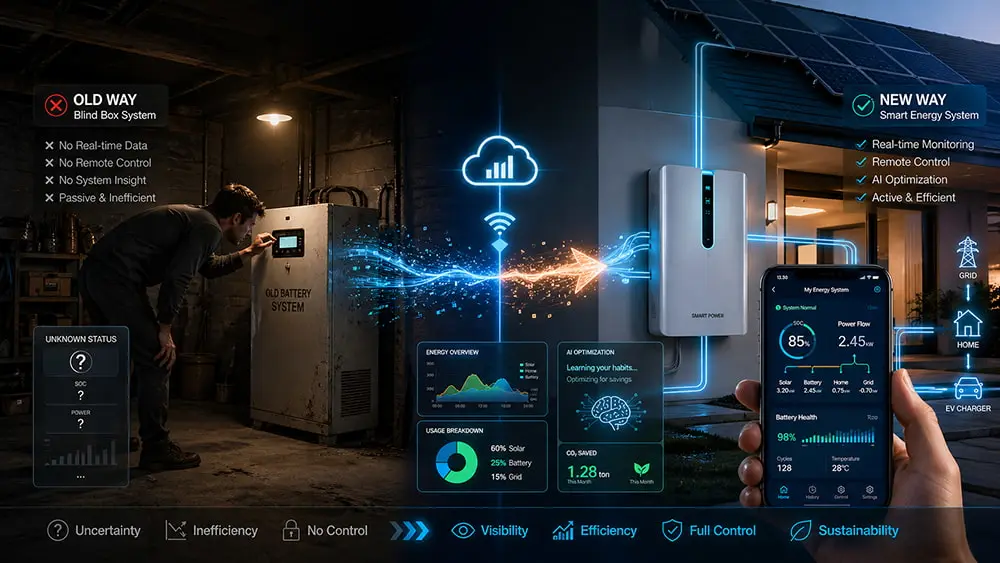
For years, buying a home energy storage battery was like buying a “blind box.” To check how much power you had left or to see if the system was running normally, you had to walk down to the garage, bend over, and squint at a tiny LCD screen on the battery cabinet.
In other words, once the battery left the factory, its intelligence was frozen in time.
Today, however, the energy landscape is shifting rapidly. With the integration of Internet of Things (IoT) technology, the introduction of a Smart BMS with WiFi is fundamentally changing how we interact with energy. Instead of being just a fancy add-on, a WiFi module transforms a passive battery box into a self-learning, remote-diagnosable, and profit-generating digital asset.
More importantly, this change is valuable for both end users and energy professionals. Whether you are a homeowner seeking peace of mind or a solar installer looking to scale your business, here is why your next battery energy storage system (BESS) must be WiFi-enabled.
Quick Answer
A Smart BMS with WiFi allows an energy storage battery to connect to a cloud platform or mobile app for remote monitoring, fault diagnosis, SOC/SOH tracking, firmware updates and energy management integration. For homeowners, it improves visibility and control. For solar installers and distributors, it reduces service costs, enables remote troubleshooting and supports future EMS or VPP applications.
Smart BMS with WiFi vs Standard BMS
A standard BMS protects the battery at the hardware level, but most of its data stays inside the battery system. Users usually need to check a local screen, connect a cable, or wait for an installer to inspect the system on site.
A Smart BMS with WiFi changes this experience. By connecting the battery to a cloud platform, mobile app, or web portal, it allows homeowners, installers, distributors, and system operators to monitor battery status remotely, review fault records, improve after-sales service, and prepare for future EMS or VPP applications.
| Feature | Standard BMS | Smart BMS with WiFi |
|---|---|---|
| Data Access | Usually viewed through an LCD screen, local cable connection, or on-site tool | View battery data remotely through an app, web portal, or cloud platform |
| Monitoring Range | Mainly limited to on-site checking | Remote monitoring from anywhere with internet access |
| Battery Status | Shows basic battery protection and operating data | Shows SOC, SOH, voltage, current, temperature, power flow, alarms, and historical records |
| Fault Diagnosis | Often requires manual inspection or an on-site service visit | Supports remote fault logs, real-time parameters, and faster troubleshooting |
| Installer Support | Installers may need to visit the site even for minor issues | Helps reduce unnecessary truck rolls and improves after-sales response speed |
| Warranty Records | Limited local data, sometimes difficult to verify later | Cloud history can provide clearer operating records for warranty and service evaluation |
| SOC/SOH Tracking | Mainly depends on local BMS algorithms and factory-set parameters | Can support cloud data analysis and OTA updates for better long-term monitoring |
| EMS Integration | Limited or unavailable | Can connect with EMS for time-of-use control, weather-based strategy, and dynamic safety limits |
| VPP Potential | Not suitable for large-scale aggregation | Can support API-based aggregation for VPP and grid service applications |
| Long-Term Value | Works mainly as a local battery protection device | Turns the battery into a connected smart energy asset with service and data value |
How a Smart BMS with WiFi Enables Remote Battery Monitoring
Yes. A WiFi-enabled Battery Management System (BMS) allows you to monitor your entire energy storage system from anywhere in the world using a smartphone app or web portal.
For homeowners, this means ultimate convenience and the end of “energy anxiety.” Whether you are sitting on your living room sofa or vacationing abroad, you can open your app and instantly view real-time data:
- SOC (State of Charge): Exactly how much power is left.
- SOH (State of Health): The real-time health and degradation status of your battery cells.
- Live Power Flow: How much energy is currently being charged from the sun or discharged to your home.
You are no longer guessing; you are in complete control of your energy independence.
Remote Troubleshooting and Warranty Protection for Installers
For solar installers, a customer calling to say “my system isn’t working” usually means one thing: an expensive “truck roll” (sending a technician to the site). Often, the technician arrives only to find a minor settings error that takes two minutes to fix.
A WiFi-connected BMS acts as a “zero-distance” diagnostic doctor, solving this painful industry bottleneck.
- Instant Remote Diagnostics: If an anomaly occurs, the homeowner simply provides the system’s Serial Number (SN). The manufacturer or installer can remotely log into the cloud platform, access real-time parameters, and review historical fault logs.
- Precision Maintenance: If a physical repair is genuinely needed, the installer already knows exactly which part has failed before leaving the office, preventing multiple trips and significantly cutting labor costs.
- Transparent Health Records: The cloud platform automatically generates a historical archive of the battery’s voltage, temperature, and cycle counts. This transparent data acts as an indisputable “warranty proof,” protecting both the consumer’s rights and the manufacturer from operating disputes.
How WiFi BMS Improves SOC Tracking and Cloud Data Learning
This is where a WiFi BMS truly separates a premium system from a basic one.
To be honest, calculating BMS SOC accuracy is notoriously difficult. A battery doesn’t have a fuel gauge. Most traditional BMS units rely on laboratory models that often drift when exposed to real-world variables like extreme cold, high humidity, or irregular charging habits, causing sudden, unexpected power drops.
A WiFi module solves this by making the BMS “smarter over time.”
Instead of relying on static, factory-set algorithms, a smart BMS uses the WiFi module as a massive data-return channel. By collecting real-time voltage, current, and temperature curves from tens of thousands of active devices globally, manufacturers can perform big data analysis in the cloud.
Using neural network models, the cloud continuously corrects the battery’s OCV (Open Circuit Voltage) curve based on actual aging and usage patterns. These optimized parameters are then pushed back to the BMS via Over-The-Air (OTA) updates.
The result? The longer you use the battery, the better the cloud understands its unique “temperament.” With continuous cloud data learning and OTA parameter updates, SOC estimation can become more accurate over time compared with a static factory-set model, especially when the system has enough real-world operating data. You get exactly the power you are promised.
BMS vs EMS: How WiFi Connects Battery Safety with Energy Strategy
This is a common question, and understanding it unlocks the true financial power of your system.
- A BMS (Battery Management System) manages the safety and health of the physical battery cells.
- An EMS (Energy Management System) manages the financial strategy of your entire home or building.
A WiFi module and its API interface are the vital bridge that connects the BMS to the EMS. Once connected, your system unlocks advanced energy management features:
- Time-of-Use (TOU) Arbitrage: The EMS pulls local electricity rate tables via the cloud. It automatically forces the inverter to charge the battery from the grid when rates are dirt-cheap (off-peak), and discharges the battery to power your home when grid prices skyrocket (peak hours).
- Predictive Strategy via Weather Link: An advanced EMS can read the weather forecast for the next 24 hours. If heavy rain is predicted and solar generation will be low, the EMS can preemptively instruct the battery to hold its charge to prevent a blackout.
- Dynamic Safety Limits: If the cloud detects rising battery temperatures from the BMS, the EMS can dynamically lower the inverter’s charge/discharge power, protecting the battery while still earning you savings.
Why WiFi BMS Matters for Installers, Distributors and VPP Projects
For distributors and large-scale installers, a WiFi-enabled BMS offers a lethal competitive advantage: Aggregation.
If you have deployed 10,000 home batteries equipped with WiFi modules, you don’t just have 10,000 isolated customers; you have a Virtual Power Plant (VPP).
Through API integration, when the national grid requires frequency regulation or peak shaving, cloud commands can be issued to make all 10,000 systems charge or discharge simultaneously. The grid operators pay substantial subsidies for this ancillary service—a massive, recurring revenue stream that standalone, offline batteries can never access.
From Battery Hardware to Smart Energy Storage Asset
The era of the “dumb battery” is over.
A standard BMS is simply a passive battery caretaker. A Smart BMS with WiFi is your personal energy analyst and a lifelong evolving partner. It doesn’t just make energy storage safer and more convenient; it upgrades the entire system from static hardware into a networked, iterative, and profit-generating smart energy service. But what if your BMS does not have a WIFI module? Learn how to upgrade your BMS with the ESP32 module.
Don’t let your next energy investment become obsolete the day it’s installed. Ensure your system is equipped with smart WiFi connectivity, and take true control of your energy future.
FAQ
A Smart BMS with WiFi is a battery management system that connects battery data to an app, web portal or cloud platform. It allows users to monitor battery status, faults, SOC, SOH and operating history remotely.
Yes. A WiFi-enabled BMS allows remote battery monitoring through a mobile app or cloud platform, depending on the system design and network connection.
A standard BMS mainly protects and manages the battery locally. A WiFi BMS can upload data to the cloud, support remote monitoring, fault diagnosis, OTA updates and energy management integration.
WiFi BMS helps installers check system status remotely, review fault logs, reduce unnecessary site visits and provide faster after-sales support.
Yes. When battery data can be accessed through cloud platforms or APIs, a Smart BMS with WiFi can support EMS strategies, time-of-use optimization and future VPP aggregation.
