It is crucial to ensure that the battery BMS is compatible with your inverter prior to purchasing an energy storage battery. This can help you avoid the hassle of returns and exchanges, reduce investment costs, and ensure a smooth setup of your energy storage system.
In this article, we’ll explain how to determine whether your inverter can communicate with the Seplos BMS.
Seplos BMS inverter compatibility depends on the communication interface, protocol version, baud rate, and pin definition supported by both the battery BMS and the inverter.
What inverters work with Seplos BMS?
Seplos has tested a variety of inverters available on the market and confirmed that they are compatible with Seplos BMS communication. You can refer to the table below to check whether your inverter’s brand and model are included.
| NO. | Brand | Protocol | Version | Communication Mode | Baud Rate | Model |
|---|---|---|---|---|---|---|
| 1 | Pylontech | CAN-Bus-protocol-PYLON | V1.3 | CAN | 500K | Applicable to all inverters using the Pylontech CAN protocol |
| 2 | Growatt-SPF | Growatt BMS CAN-Bus-protocol-low-voltage | V1.05 | CAN | 500K | SPF 5000TL HVM-WPV-P, SPF 5/6/8/10KT HVM |
| 3 | Growatt-SPH | Growatt BMS communication protocol for Growatt low voltage battery | V1.01 | CAN | 500K | Growatt SPH 5000 |
| 4 | Goodwe | Goodwe Communication Protocol | V1.5 | CAN | 500K | GW3648D-ES |
| 5 | Sofar | Sofar Solar Energy Storage Inverter BMS Universal CAN Protocol Description | V1.0 | CAN | 500K | HYD 3000-ES |
| 6 | SMA | FSS-ConnectingBat-TI-en-20W | V2.0 | CAN | 500K | SI6.0,SI8.0H-13 |
| 7 | Victron | can-bus_bms_protocol | V1.0 | CAN | 500K | MultiPLUS-II |
| 8 | Studer | Technical specification Studer BMS Protocol | V1.03 | CAN | 500K | XTM 4000-48 |
| 9 | Ginlong | CAN communication protocol | V1.0 | CAN | 500K | RHI-5K-48ES, Solis_EO_5G_ENX, S5-EO1P5K-48-P, S6-EH1P6K-L-EN |
| 10 | Sungrow | CAN-Bus-protocol-PYLON | V1.3 | CAN | 500K | SH5K-30 |
| 11 | Chint Power | Chint+Power CAN bus protocol V1.0.0 | V1.0 | CAN | 500K | CPS SCE6KTL-120/EU |
| 12 | Luxpowertek | Luxpowertek Battery CAN Protocol | V1.0 | CAN | 500K | SNA5000 WPV, LXP6K |
| 13 | Sol-Ark | Sol-Ark CAN Bus Protocol | V1.2 | CAN | 500K | Sol-Ark 8K & 12K |
| 14 | TBB | TBB Lithium Battery BMS Platform CAN Communication Protocol V1.02 | V1.02 | CAN | 500K | RiiO Sun 5KVA-S, CA3090L |
| 15 | Deye | CAN-Bus-protocol-PYLON-v1.3 | V1.0 | CAN | 500K | SUN-3 6KSG03LP1-EU |
| 16 | Sunsynk | CAN-Bus-protocol-PYLON | V1.3 | CAN | 500K | SUN-3K-SG04LP1-24-EU, SUN-3.6K-SG04LP1-EU, SUN-5K-SG04LP1-EU, SUN-6K-SG04LP1-EU |
| 17 | Livoltek | LIVOLTEK CANBUS Protocol of Low Voltage System V1.0 | V1.0 | CAN | 500K | GF1-3K48S1, GF1-5K48S1 |
| 18 | Sorotec | 2_CAN Protocol1.0 | V1.0 | CAN | 500K | REVO III 5.5-8KVA |
| 19 | megarevo | TBB Lithium Battery BMS Platform CAN Communication Protocol V1.02 | V1.01 | CAN | 500K | REVO_RKL1, R8KLNA, R5KL1 |
| 20 | Afore | Luxpowertek Battery CAN Protocol | V1.0 | CAN | 500K | AF3K-SL, AF5K-SL |
| 21 | Sacolar | Growatt BMS CAN-Bus-protocol-low-voltage | V1.05 | CAN | 500K | SP Series |
| 22 | Must | CAN-Bus-protocol-PYLON | V1.3 | CAN | 500K | PV1800 Pro Series (3/5.2KW) |
| 23 | INVT | CAN-Bus-protocol- | V1.3 | CAN | 500K | INVT iMarsXD6KTL |
| 24 | Voltronicpower | Voltronic Inverter and BMS 485 communication protocol | V1.0 | RS485 | 9600 | InfiniSolar VII, GSDHW VIV-6KW |
| 25 | SRNE | PACE BMS Modbus Protocol for RS485 | V1.3 | RS485 | 9600 | HF4850S80-H, HF4850S80-145, HF2430S60-100, HES4855S100-H |
| 26 | Growatt-SPF | SPF BMS RS485 Protocol | V2.01 | RS485 | 9600 | SPF 5000TL HVM-WPV-P, SPF 10KT HVM |
| 27 | Pylontech | RS485-protocol-pylon-low-voltage | V3.5 | RS485 | 9600 | Applicable Pylontech 485 protocol data summary inverter 3K |
| 28 | Deye | RS485-protocol-pylon-low-voltage-New Protocol Design-Deye NO.12 9600 | V1.0 | RS485 | 9600 | SUN-3 6KSG03LP1-EU, SUN-12K-SG04LP3-EU |
| 29 | EAsun | Voltronic Inverter and BMS 485 communication protocol | V1.0 | RS485 | 9600 | IGrid SV IV 5.6KW |
| 30 | MPP Solar | Voltronic Inverter and BMS 485 communication protocol | V1.0 | RS485 | 9600 | MPI WP 12_15KW |
| 31 | Bentterson | RS485-protocol-pylon-low-voltage-New Protocol Design | V1.0 | RS485 | 9600 | SAL 3.5KW-UL, SAL 5KW-EU |
| 32 | Johnray | johnray-PYLON | V1.0 | CAN | 500K | Applicable to all inverters using the Pylontech CAN protocol |
| 33 | Solax | CAN-Bus-protocol-PYLON | V1.3 | CAN | 500K | X1-HYB-LV |
| 34 | Renac | CAN-Bus-protocol-PYLON | V1.3 | CAN | 500K | Renac-ESC5000-DS |
| 35 | Hoymiles | CAN-Bus-protocol-PYLON | V1.3 | CAN | 500K | HYS-5.0LV-EUG1 |
| 36 | Each Energy | CAN-Bus-protocol-PYLON | V1.3 | CAN | 500K | PLS8K/10K/12K-M1 |
| 37 | OLU | CAN-Bus-protocol-PYLON | V1.3 | CAN | 500K | OLU5048GII |
| 38 | Hinen | CAN-Bus-protocol-PYLON | V1.3 | CAN | 500K | Hinen-SH6KL |
| 39 | Hypontech | CAN-Bus-protocol-PYLON | V1.3 | CAN | 500K | HBT 5-12K |
| 40 | Aiswei | CAN-Bus-protocol-PYLON | V1.3 | CAN | 500K | ASW5000H-S2 |
| 41 | Senegy | CAN-Bus-protocol-PYLON | V1.3 | CAN | 500K | SE 6KHB-120 |
| 42 | AOTAI | Aotai Lithium Battery BMS Platform CAN Communication Protocol V1.02 | V1.02 | CAN | 500K | AEP-3/3.6/5KS48P |
| 43 | CVTE | CAN-Bus-protocol-PYLON | V1.2 | CAN | 500K | 5KW Inverter |
| 44 | SOSEN | CAN-Bus-protocol-PYLON | V1.2 | CAN | 500K | |
| 45 | AP Systems | CAN-Bus-protocol-PYLON | V1.3 | CAN | 500K | APstorage ELS Series |
| 46 | Austa | CAN-Bus-protocol-PYLON-v1.3 | V1.3 | CAN | 500K | SUN-3 6KSG03LP1-EU, SUN-10/12K-SG04LP3-EU |
| 47 | YelonESS | CAN-Bus-protocol-PYLON-v1.3 | V1.3 | CAN | 500K | HV6K-1L single-phase low voltage |
| 48 | Xindun | SPF BMS RS485 protocol | V2.01 | RS485 | 9600 | LS-T50248-W60, HP-pro50248 |
| 49 | Techfine | RS485-protocol-pylon-low-voltage | V3.5 | RS485 | 9600 | GB5548JMH |
| 50 | CVTE | RS485-protocol-pylon-low-voltage | V3.5 | RS485 | 9600 | 5KW Inverter |
| 51 | NEXT | RS485-protocol-pylon-low-voltage | V3.5 | RS485 | 9600 | MAX PRO-7.2/8.2/10.2KW, NM-ECO-3.6/4.2/6.2KW PLUS |
| 52 | Snadi | RS485-protocol-pylon-low-voltage | V3.5 | RS485 | 9600 | NKH-6K-IP54 |
| 53 | Evada | RS485-protocol-pylon-low-voltage | V3.5 | RS485 | 9600 | EVS5048H |
| 54 | Chisage ESS | RS485-protocol-pylon-low-voltage | V3.5 | RS485 | 9600 | Mars-5/6/8/10/12/14G1-LE |
| 55 | SMK Solar | Lithium Battery Protocol GT Edition | V1.0 | RS485 | 9600 |
But if your inverter’s brand and model are not listed, what should you do?
Don’t worry — you can follow the steps below to seek assistance from a Seplos engineer.
For systems using Victron, Growatt, or other inverter brands, confirm the required CAN or RS485 protocol before wiring, because a matching connector does not necessarily mean that the BMS communication settings are compatible.
Part 1: Review the Specification of the Inverter
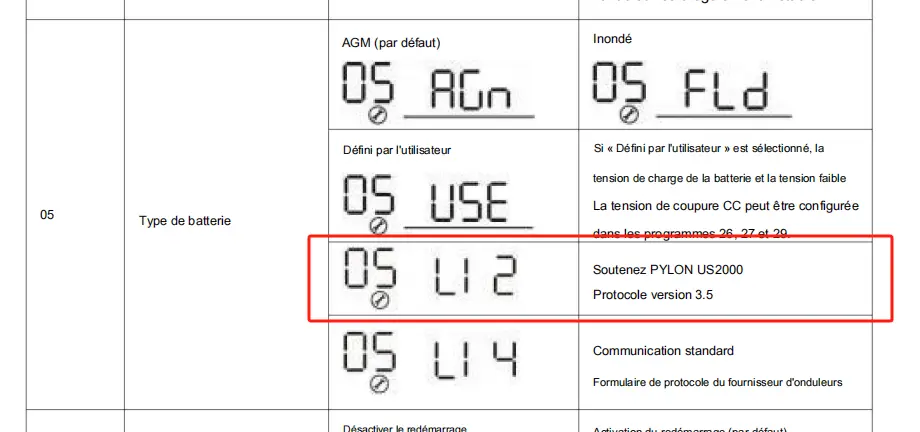
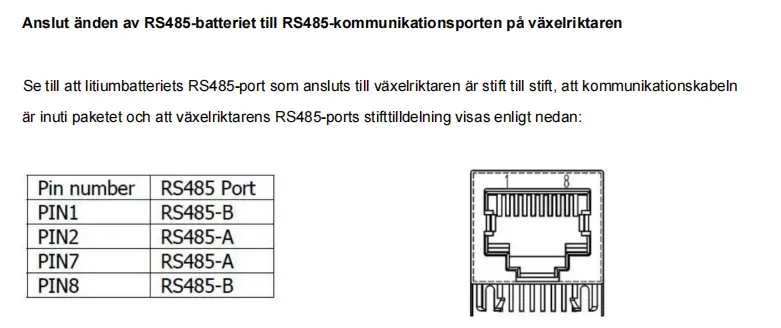
As most inverters support the Pylon CAN protocol, what you need to do is check the user manual of the inverter to see whether it uses the Pylon CAN or Pylon 485 protocol, as well as the pin configuration.
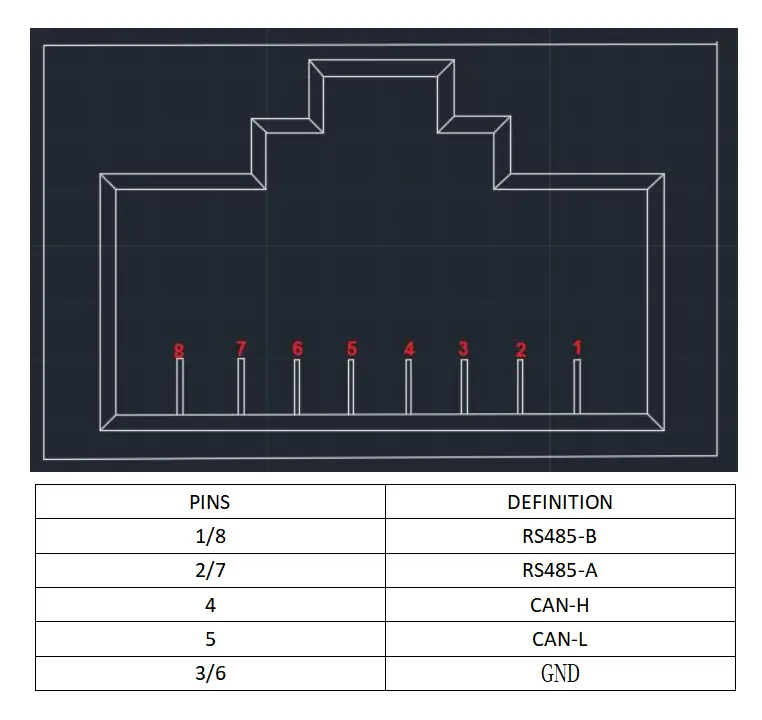
If the inverter supports the Pylon CAN protocol, check its manual to verify that the PIN definitions match those of the Seplos BMS. A matching PIN definition allows direct communication between the inverter and the BMS. If the definitions differ, adjust the PIN configuration accordingly.
Seplos BMS PIN Definition:
When using RS485 communication, compare the Seplos RS485 pinout with the inverter port definition before connecting the communication cable.
Inverter PIN Definition:
Part 2: Send the Protocol to Seplos Engineers
Seplos engineers maintain a list of communication protocols that have already been tested. Any inverter included in this list can communicate seamlessly with Seplos energy storage batteries. To confirm compatibility, simply send your inverter’s communication protocol to the Seplos engineering team.
Part 3: Modify the Protocol if Necessary
For the RS485 protocol, most inverter manufacturers use different communication standards, which may result in communication failure. To avoid this issue, please confirm the compatibility with your sales representative before purchasing a Seplos BMS or Seplos energy storage battery. However, if you forget to do this step, you will need to coordinate with the inverter manufacturer to modify the protocol and ensure your energy storage project operates smoothly.
Part 4: Ask Custom Protocol from Seplos
If the inverter manufacturer uses a completely new communication protocol, it will not be compatible with the Seplos BMS by default. In this case, you will need to provide the latest protocol documentation to the Seplos engineering team. If necessary, Seplos can develop a custom protocol to enable compatibility.
With more than 8 years of experience in R&D and manufacturing in the energy storage field, Seplos has developed a BMS that can communicate with most mainstream inverters on the market. However, there are many inverter manufacturers, each using different manufacturing standards and communication protocols. We cannot eliminate these differences, but please remember that if you have any questions or concerns about inverters or energy storage systems, do not hesitate to contact us. Seplos is customer-centric and committed to providing the best LiFePO4 battery and services for every energy storage user.
FAQs About Seplos BMS Inverter Compatibility
Check whether the inverter and Seplos BMS support the same CAN or RS485 communication protocol, baud rate, protocol version, and connector pin definition. Physical connection alone does not confirm communication compatibility.
Some Seplos BMS models can communicate with compatible Victron systems through a supported CAN communication protocol. Confirm the BMS model, Victron device, firmware version, cable pinout, and selected communication settings before installation.
Seplos BMS can work with supported Growatt inverter models when both devices use a compatible communication protocol. Check the inverter model, battery protocol setting, CAN or RS485 interface, and the latest Seplos compatibility information.
The RS485 pinout identifies the RS485-A, RS485-B, and ground connections used by the Seplos BMS communication port. Always compare the Seplos port definition with the inverter manual before making the cable.
Check the inverter manual for its supported battery protocol, interface, baud rate, and pin definition. Send this information to Seplos engineers to confirm compatibility or determine whether a custom communication protocol is required.